
5 Advanced Real Estate Negotiation Tactics
The Hidden Architecture of a Property Deal: Command Any Conversation in 30 Seconds
Stop asking naked questions and losing the mandate. Master the 5 statements and 5 questions that neurologically command trust and authority in the South African market.
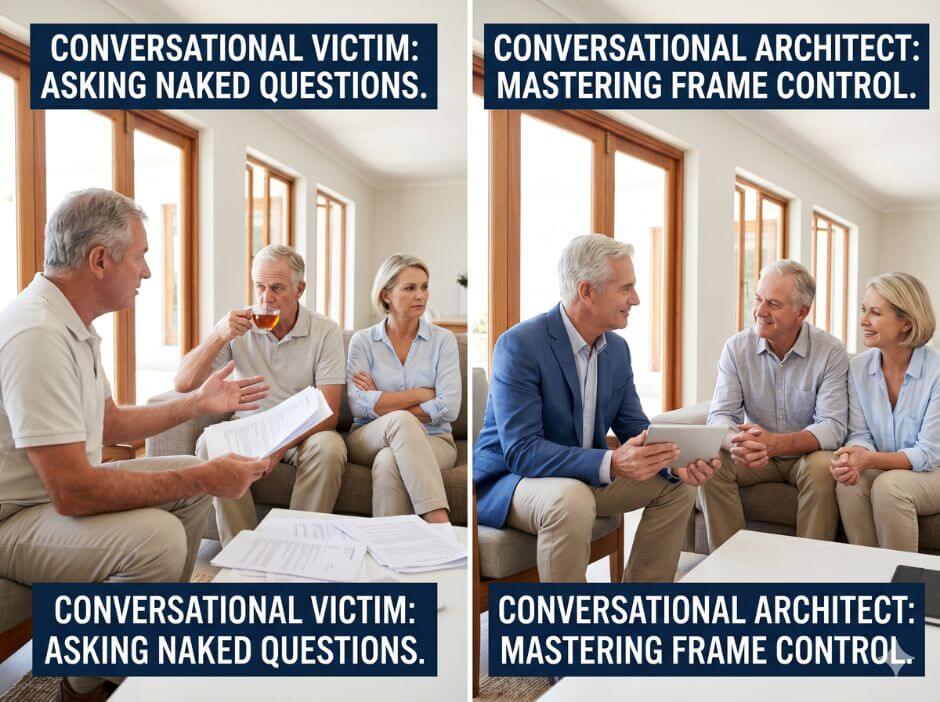
You sit in a living room in Bellville, sipping lukewarm rooibos. You have prepared the perfect comparative market analysis. Your marketing plan is absolutely faultless.
You lean forward and ask the seller, “What are you hoping to get for the house?” The atmosphere suddenly turns freezing cold. You just lost the mandate. You did not use the wrong words, but you completely lost the frame.
This is the exact moment the seller stops seeing you as an expert. They now see you as just another agent begging for a listing. To transition from conversational victim to conversational architect, you must change your approach.
You must master advanced real estate negotiation tactics. Stop relying on naked hope. Start building the hidden architecture of agreement.
The Myth of the 'Naked Question': Why Good Agents Lose Deals

The Doctor's Office Analogy: How Language Installs Reality in a Living Room
Every conversation operates on an invisible architectural framework. This structure shapes perception before conscious thought can even intervene.
When you visit a medical professional, they never start by begging for your symptoms. They walk in and say, “It looks like we have been dealing with this for a while now.” Notice the immediate and subtle shift in power.
The doctor installs a framework of shared control before you can process it. They follow up with, “What are we hoping to accomplish today?” Within ten seconds, you transform from an individual with complaints into a collaborative patient.
The doctor defined the scope of acceptable desires without asking for permission. This is the core of real estate negotiation psychology. If a doctor can command your trust this quickly, you can do exactly the same in a seller’s lounge.
Real estate agents often walk into a home and surrender their power immediately. You must build the room before you ask someone to sit inside it.
Why Asking 'What's your bottom line?' Surrenders Your Authority
We are falsely taught that asking questions puts us in the driver’s seat. This is a complete myth in high-stakes environments. Asking a question without a framing statement creates a “naked question.”
Naked questions solidify existing frames rather than establish brand new ones. If you ask a question from a position of lower authority, you simply confirm that authority.
Think of a lawyer asking about a settlement before a trial begins. They are just showing their weak hand. If you ask a Durbanville investor for their bottom line, you are confirming their dominance. You are playing their game, entirely by their rules.
Naked questions make you look like a subordinate seeking simple approval. When you ask an unanchored question, you give away your power completely.
The Core Rule: Statements Set the Frame, Questions Lock the Door
The golden rule of controlling real estate conversations is incredibly simple. Statements set the initial frame of the discussion. Questions securely lock people inside that specific frame.
You cannot ask a seller to trust your valuation without first building a reality where it makes sense. You must state the undeniable facts before you ask the challenging questions. If you reverse this order, you sound unconfident and weak.
The combination of a framing statement and a constraining question creates deep psychological acceptance. This happens automatically, without requiring explicit agreement from the client.
Every interaction is an invisible architectural structure of statements and questions. If you control that sequence, you control the entire property transaction from start to finish.
The 5 Statement Classes: Architecting the Mandate Presentation

The Concept (Pacing) & The Application (Stating the undeniable reality of current interest rates to a Brackenfell seller)
Pacing is the simplest and most foundational technique in your conversational toolbox. A pacing statement simply describes what is already observably true. You are stating a reality exactly as it exists in the world.
When someone hears a true statement, their nervous system generates a microagreement below conscious awareness. This creates a psychological “yes” that subsequent statements and questions can safely ride on.
Imagine you are sitting with a highly stubborn seller in Brackenfell. Do not argue with them about their completely inflated asking price. Instead, say: “Interest rates have stayed consistently high for the last three quarters.”
This is pure pacing, and it is a fact that they cannot fight. They nod internally, and their resistance instantly drops. You are not pushing them at all. You are standing next to them, looking directly at the same harsh market reality.
The Concept (Alignment) & The Application (Collapsing the adversarial commission frame with a Durbanville investor)
Alignment statements differ from pacing by describing shared intent rather than shared reality. You are declaring a common goal or a mutual purpose before anyone commits. This fundamentally collapses the adversarial dynamic in any room.
Alignment triggers cooperation mode in the brain, making resistance appear completely irrational. If you declare a shared purpose, pushing back makes the other person look like they are rejecting collaboration.
Consider a tough negotiation with an aggressive property flipper in Durbanville. They are fully prepared to fight you on your commission percentage. Before they can even speak, you use a strong alignment statement.
“My primary goal here is to make sure your net profit stays exactly where you need it for your next project.” You have just positioned yourself as their dedicated financial protector. If they fight you now, they are literally fighting their own profit margins.
The Concept (Resonance) & The Application (Naming a seller's anxiety about market stagnation before they do)
Resonance requires the most sophisticated observation skills of all the statement classes. It involves naming the other person’s internal emotional state or hidden priority. You must reflect their frustration before they have to articulate it themselves.
When executed accurately, the physical response is immediate and highly visible. You will literally watch their shoulders drop as the fight evaporates from their body. You are sitting with a couple whose home has been listed with three other agencies.
Instead of launching into your marketing pitch, you use deep resonance. “I know you are incredibly frustrated because this house has sat empty for six months, and nobody has given you a straight answer as to why.”
You have named the ghost hiding in the living room. They stop preparing for a confrontation because you already see their pain. This is the most powerful tool for handling seller objections Cape Town style.
The Concept (Concession) & The Application (Disarming the 'your valuation is too low' counterattack preemptively)
A concession statement involves voluntarily giving up a little bit of ground early on. You acknowledge a clear limitation, a high cost, or a difficult reality upfront.
The true power of concession lies in its preemptive disarmament. You remove the ammunition from their counterattack before it can even be launched.
When you make a concession first, you signal that you are not threatened by the truth. Paradoxically, this positions you as the one in total control. You know the seller is going to absolutely hate your market valuation.
Before you show the number, you actively concede the difficulty. “I know this comparative analysis is going to be incredibly difficult to look at today.” You just completely disarmed their anger. A well-placed concession earns you the absolute right to ask very hard questions later.
The Concept (Presupposition) & The Application (The sharpest tool for closing a sole mandate in Bellville)
Presupposition is universally considered the sharpest tool in the entire frame-control kit. It embeds an assumption as a hard fact by treating it as already established.
The assumption lives silently like a solid foundation under a house. These statements operate completely below the level of conscious challenge.
Challenging a presupposition requires the listener to stop the conversation and aggressively contradict you. You want to cleanly close the sole mandate for a prime property in Bellville.
You never ask, “Will you sign the mandate with me today?” Instead, you firmly state: “Since we are launching the aggressive marketing campaign next Tuesday…” You are treating the mandate as a decided, historical fact.
To stop you, the seller has to actively pick a fight and halt the conversational momentum. Most people will simply accept the embedded reality and move comfortably forward.
The 5 Question Types: Guiding the Buyer's Psychology

The Concept (Directional) & The Application (Moving a buyer past the 'if' to the 'how' on a Kuils River property)
After establishing frames with statements, questions securely lock people inside them. Directional questions guide the other person toward a specific conclusion without stating it.
You carefully build a psychological hallway that only goes in one logical direction. You then simply invite the other person to walk down it. The buyer arrives at the conclusion themselves, making it their own unshakeable idea.
A young family is hesitating on a perfectly priced home in Kuils River. Do not simply tell them the area is growing and they should buy now. Instead, ask: “What do you think happens to these property values when the new private school opens down the road next year?”
They do the simple math inside their own heads. They naturally convince themselves to buy without feeling heavily sold to. This forms the bedrock of highly effective buyer communication strategies.
The Concept (Assumptive) & The Application (Treating the offer as accepted to discuss bond origination details)
Assumptive questions completely bypass the main decision you want the client to make. They jump straight over it and ask only about the implementation details.
The actual choice you want them to make is never explicitly questioned. It is comfortably treated as already made and finalized. By asking about the next step, you force their brain to accept the previous step.
The buyer is pacing around the living room, nervous about signing the offer. Do not ask if they are finally ready to sign the document.
Ask: “When we send this to the bond originators tomorrow, do you want to use your current bank or shop around for better rates?” The monumental decision to buy the house is deeply embedded. They are now only deciding on the minor paperwork process.
The Concept (Elicitation) & The Application (Extracting actual budget info without a financial interrogation)
Elicitation questions are the art of extracting highly sensitive information smoothly. Direct questions about money or constraints often trigger massive defensive walls.
Elicitation feels exactly like two people just thinking out loud together. It gathers vital intelligence without ever alerting the other person to your intent.
You desperately need to know a buyer’s real, unfiltered maximum budget. Instead of aggressively asking, “What is your maximum limit?”, you use calm elicitation.
“I have been trying to figure out how families in your tax bracket usually structure their bonds for properties this size.” It is phrased as a statement that naturally invites them to share information. They will spill their financial secrets without feeling interrogated.
The Concept (Reframe) & The Application (Shifting the lens on a lowball offer from an aggressive buyer)
Reframing questions instantly swaps the lens the other person is looking through. You change the entire context of the problem without openly announcing it. The question itself becomes the sudden, powerful shift in perspective.
Reframing takes an adversarial demand and turns it into a logical puzzle to solve. An aggressive buyer submits an offensively low offer on a well-priced listing. They loudly claim the house needs entirely too much cosmetic work.
You look at them and calmly ask: “What if this is not a renovation problem? What if this is simply a structural pricing advantage for you?”
You just changed the entire narrative of the negotiation. Anyone continuing to argue about paint colors now looks completely foolish.
The Concept (Diagnostic) & The Application (Positioning yourself as the evaluator when buyers demand unreasonable repairs)
Diagnostic questions covertly position you as the ultimate authority in the room. They make you the evaluator and the other person the one being assessed.
Phrases like “Help me understand” create the firm impression that you need to be satisfied. The person explaining their logic is never the person holding the power in the room.
A buyer aggressively demands that the seller replace the entire roof before transfer. You do not say no immediately or get defensive.
You lean back and ask: “Walk me through exactly how you arrived at the conclusion that the roof is structurally compromised.
” You have just forced them to show their detailed homework. You are the teacher grading their paper, cementing your frame control in property sales.
The Redirect Protocol: What to Do When the Seller Says No

Why 'Trying Harder' Looks Like Desperation to a Cape Town Homeowner
Even the most skilled conversational architects will sometimes miss the mark. When a carefully planned frame fails to land, your natural instinct is dangerous.
You instinctively want to double down, explain more, and try much harder. This is a fatal mistake in any negotiation. The moment a client visibly sees your effort, the entire game is over.
If you become the person desperately reaching, the seller will lean back and watch. Desperation has a very distinct, unpleasant smell in the Northern Suburbs.
If you try the same approach harder, you look totally unskilled and weak. True professionals never force a broken tool into a rigid lock. Frame control failures are simply opportunities to gather valuable data.
Read, Release, Shift, Deploy: The 4-Step Recovery for a Blown Pitch
When a conversation stalls, you must execute the four-step redirect protocol instantly. Step One is to rapidly read the miss. Determine exactly why the frame failed, whether they were distracted or actively resisting.
Step Two is to completely release the broken frame. Drop whatever you tried to install and absolutely never reference it again. Trying to salvage a dead conversational point makes you look totally incompetent.
Step Three requires you to abruptly shift the statement class. If a pacing statement was rejected, smoothly move straight into resonance or concession.
Step Four is to deploy the brand-new pairing. Use the new statement class with a completely different question type. You now have fresh, highly accurate data about what the seller actively protects.
Conclusion: Becoming the Architect of the Western Cape Transaction
You now understand the hidden mechanics operating beneath every single living room chat. This is not a collection of cheap manipulation tricks or temporary sales hacks.
This is the fundamental structure of how language installs reality in the human mind. Most people lose negotiations because they operate blindly inside frames they do not own.
When you face resistance, you will not panic; you will simply redirect. Control the sequence, protect your client, and dictate the terms of the deal. You are no longer reacting helplessly to a chaotic property market.
By mastering these advanced real estate negotiation tactics, you become the true architect of the transaction. Build the room, guide the conversation, and command the outcome.
The Architect’s Note: The Science of Influence The conversational architecture and psychological frameworks detailed in this guide are heavily adapted from the work of Chase Hughes, a leading authority on behavior profiling and influence. To study the raw mechanics behind the real estate tactics discussed above, I highly recommend watching his original breakdown: [Chase Hughes – The 5 Sentences That Turn The Tables].
About the Author
Andre Swart is a respected leader in Brackenfell real estate with over 20 years of results-driven experience. Through his platform, “Andre Swart Inspires,” he moves beyond simple property sales to share the proven mindset, strategies, and habits that build lasting success.
Grounded in integrity, Andre’s mission is to mentor the next generation of top agents and provide homeowners with the trusted guidance they deserve.