
How To Accurately Value a House in Brackenfell
Advanced Property Valuation Dynamics in Brackenfell: A Methodological Blueprint for Protea Hoogte
Stop Relying on Algorithms: The True Science of Property Valuation in Brackenfell.

Pieter checked his phone on a Sunday night. Lightstone said his Protea Hoogte home was worth R2.6 million. His neighbour, two doors down, sold for R3.1 million last year with the same size stand. Same street. Same bones. Different number entirely.
That gap keeps homeowners up at night. Price too high, and your home sits on the market for months while buyers whisper about it. Price too low, and you hand a stranger money that should have stayed in your pocket.
Here is the plain truth: learning how to accurately value a house in Brackenfell Cape Town takes more than a report pulled off a database.
It takes someone who knows which side of your street sits on bad clay, and which renovations actually pay for themselves. In this guide, we walk through exactly what your algorithm missed, and what your home is really worth.
The Limitations of Lightstone Property Valuations in Brackenfell
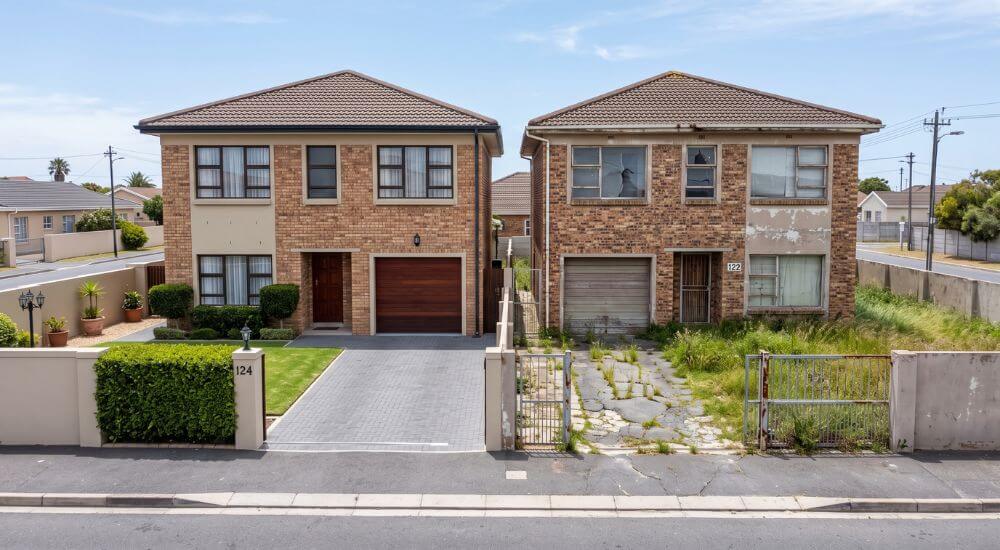
Automated Valuation Models, or CAMA systems, price your home using historical sales data and basic measurements like square meterage, without anyone ever walking through the front door.
Lightstone is the name most homeowners know, and municipal valuation rolls run on the same logic.
When looking at the limitations of Lightstone property valuations in Brackenfell, the problem is simple: a CAMA system cannot tell the difference between a home maintained for twenty years and the identical house two doors down that has been neglected since 2015.
Both show the same erf size and bedroom count on paper. In reality, one might need R300,000 spent just to bring it up to a sellable standard, and the algorithm has no way of knowing that.
This gap is not small. A valuation pulled from municipal records and average sale prices captures, at best, only half the real picture.
The City of Cape Town’s current General Valuation Roll, reassessing close to 970,000 rateable properties ahead of the new rates cycle starting July 2026, runs on this same blunt logic.
It was built to set municipal rates fairly across a whole city, not to price your specific home for a buyer standing in your kitchen.
Any number that comes off a desktop, without a person walking your property, is a starting point at best. It is not the answer.
The Protea Hoogte Market Context and Demographic Stability
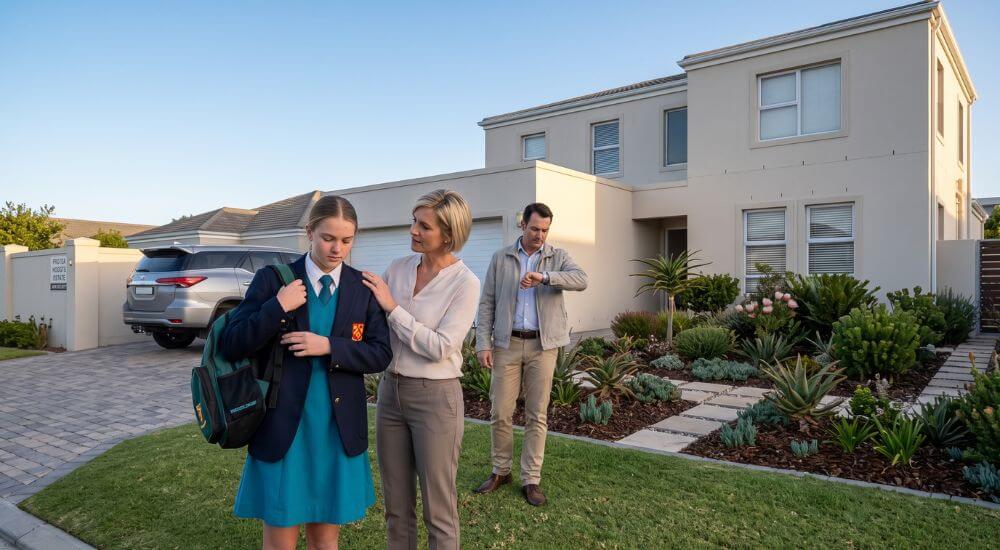
Protea Hoogte is a stable, family-focused suburb in Brackenfell South made up of roughly 3,889 residential properties, and most owners here stay for years, not months.
The property mix breaks down like this: 59.48% (2,313) are non-estate freehold homes, 27.82% sit inside secure estates, and sectional title makes up the smallest share, 10.44% outside estates and 2.26% inside.
Own a freehold home outside an estate, and you are in the majority, with a deep pool of comparable sales to draw on.
Buyers here fall into the LSM 10 bracket: high income, family-focused, drawn by good schools like Laerskool Bastion Primary and Protea Heights Academy.
And 56% of homeowners have stayed eleven years or longer, which means condition varies wildly between homes built in the same era. Some have been kept up. Others have quietly aged.
Pricing reflects this. The suburb averages R2.52 million overall, but non-estate freehold homes average R3.18 million. A 3-bedroom home averages R2.44 million, a 2-bedroom R2.18 million.
| Property Type | Average Size | Average Bedrooms | Estimated Sale Price |
|---|---|---|---|
| House (General Average) | 217 m² | 3 | R2,831,297 |
| 2-Bedroom House | 121 m² | 2 | R2,186,286 |
| 3-Bedroom House | 227 m² | 3 | R2,444,325 |
| Freehold (Non-Estate) | Varies | 3–4 | R3,183,016 |
These numbers set a ceiling and a floor. What they cannot explain is why two near-identical 3-bedroom homes on the same street sell hundreds of thousands of Rand apart. That gap comes down to soil, compliance, and how the money was spent, or wasn’t.
Algorithmic Blind Spots: The Gentrification Bias and Geological Realities
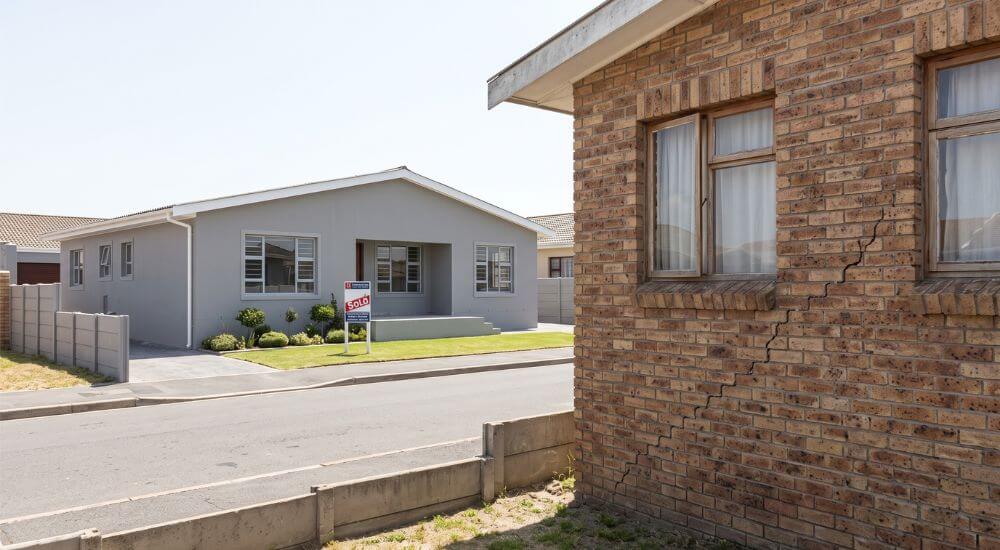
Automated valuation tools get fooled by renovated homes that skew a street’s data upward, and by clay soil damage that no satellite photo can catch. Both blind spots hit Protea Hoogte hard.
Here is the first problem, known in the industry as the “renovation penalty.” A developer buys an older home on your street, guts it, and sells it at a premium.
The algorithm sees that one high sale and lifts the baseline value for the whole street, including the untouched 1980s original next door with its cracked linoleum and old wiring. The computer cannot tell a showpiece from its tired neighbour. It just sees a high number and spreads it around.
The second problem runs deeper, literally. The Northern Suburbs sit on expansive “bull tallow” clay, soil that swells in winter and shrinks in summer.
That constant movement stresses foundations over time, causing cracks, bowed walls, and separating brickwork. A desktop valuation works off aerial photos and deeds data.
It cannot see a hairline crack in a foundation wall. A buyer walking through in person can, and will cut their offer accordingly to cover underpinning costs.
This is why two nearly identical homes on the same street can sell for figures hundreds of thousands of Rand apart. Neither story shows up in a Lightstone report. Both show up the moment a real valuer walks through the front door.
The Scientific Framework: Hedonic Pricing and the Sales Adjustment Grid

Hedonic pricing is a method that breaks a home’s value down into its separate parts, then puts a Rand figure on each one. Instead of treating your house as one lump sum, this approach treats it as a collection of features:
The kitchen, the bathrooms, the roof, the solar setup, all priced out on their own. Add them together, along with the base value of the location, and you get a number that actually reflects what is standing on the stand, not just what the street average says.
The formula, in plain terms. You may see it written as:
Do not let the symbols put you off. P is the final price. β0 is your location's base value. Each X is a specific feature of your home, like a bathroom count or a certified solar system. Each β is what the market pays for that feature. And ε is the leftover noise: emotion, timing, negotiation.
How this works in practice. A real valuer does not solve equations. They use a Sales Adjustment Grid, picking three to five recent comparable sales and adjusting each one up or down based on what is different.
Say a comparable sold for R2.8 million with a renovated kitchen and solar installed. Your home still has its original 1990s kitchen and runs off municipal power alone. The valuer subtracts the value of that kitchen and that solar system from the comparable’s price, working backward to find what your home would actually fetch.
This is the difference between guessing and calculating. A Lightstone report averages numbers without asking why they differ. A Sales Adjustment Grid asks that question for every line item, and answers it in Rand.
Strategic Capitalization and the Anatomy of the Price Ceiling

Overcapitalization happens when a renovation costs more than the market ever pays back, no matter how good it looks. Every neighbourhood has a price ceiling, a rough limit on what buyers will pay to live there, and Protea Hoogte is no exception.
The Northern Suburbs have grown into a real business hub, home to head offices like The Foschini Group, Pepkor, and Shoprite. That brings steady buyers, but steady is not unlimited. LSM 10 buyers have a clear budget, and no amount of marble pushes past it.
Spending money does not automatically create equal value. The question is whether it went where the market wants it, or just where the owner personally wanted it. Converting a garage into a gym, or a bedroom into a walk-in closet, might suit the current owner.
But it strips out something LSM 10 buyers treat as non-negotiable: secure parking and enough bedrooms. A valuer has to price in the cost of undoing that change.
Before spending on a renovation, ask whether it adds something the next buyer will pay for, or just suits how you live now. The market rewards utility, not personal taste.
Also read: Guide to Maximising Property Value
ROI on Kitchen and Bathroom Renovations in Protea Hoogte

The ROI on kitchen and bathroom renovations in the Northern Suburbs beats almost every other upgrade, with kitchens returning 70% to 80% and bathrooms 60% to 75%.
Kitchens lead the pack. A full renovation can lift a home’s value by around 20%, and owners typically recoup 70% to 80% of what they spend. It makes sense: the kitchen is where families actually live, and buyers form an opinion about the whole house the moment they walk in.
Bathrooms come second. An upgrade can raise value by an average of 16%, recovering 60% to 75% of cost. An en-suite off the main bedroom performs especially well, since LSM 10 buyers see it as standard, not a luxury.
Cosmetic fixes punch above their weight too. New energy-efficient windows can lift value by up to 13%. A full neutral repaint can add another 12%. Neither needs months of construction, just a fresh, cared-for feel.
The biggest returns rarely need the biggest budgets. Paint and windows can outperform a garage conversion, simply because they fix what buyers notice first.
The Psychology of Buyer Assessment: The Price Eroding Phenomenon
Price eroding happens when a buyer sees a small, cheap flaw and mentally deducts far more than it would cost to fix. It is not rational. It is a gut reaction, and it shows up in almost every walkthrough of an older Protea Hoogte home.
Peeling paint in a hallway might cost R5,000 to fix professionally. But a buyer standing there does not do that maths. They think about hassle: finding a contractor, the mess, the time.
So instead of deducting R5,000, they deduct R15,000 to R20,000 in their head. The flaw barely matters. Their imagination does the damage.
A structurally sound but cosmetically tired home takes a bigger price hit than the real repair cost justifies. For sellers, the fix is cheap: a full neutral repaint before listing.
It removes the buyer’s chance to do that negative maths altogether, one of the cheapest ways to defend your price in the whole process.
SSEG Solar Compliance Certificate Requirements in Brackenfell

A solar system adds real value to a Brackenfell home, between 3% and 8%, but only with proper SSEG registration and a valid compliance certificate. Without that paperwork, it is not an asset. It is a liability waiting to surface.
Grid independence matters more than ever with loadshedding still part of daily life. A home with working solar, ideally with battery storage, gives buyers lower bills and peace of mind.
The City of Cape Town’s Cash for Power initiative adds further appeal, letting owners with a compliant SSEG system sell surplus power back to the grid for credit or cash.
But a valuer cannot simply add the retail price of a solar system to a home’s value. The whole value rests on compliance: SSEG registration and an electrical certificate confirming the installation is safe.
Without both, an uncertified system is worth less, not more, since it becomes a fire risk and a legal problem the new owner inherits.
Check your paperwork before listing. Registered and certified, solar earns its place in your valuation. Uncertified, it drags the number down.
Does a Swimming Pool Add Value to a House in Brackenfell?

If you are asking does a swimming pool add value to a house in Brackenfell, the answer for Protea Hoogte is often no, as in most cases, it works against the seller.
This runs against an old myth that a pool adds around 15% to a home’s value. That idea does not hold up anymore.
A new pool costs R150,000 to R400,000, a serious outlay for a feature buyers increasingly see as a burden. Drought memories, rising water tariffs, chemical costs, and expensive pool pumps have all shifted buyer sentiment.
For most families in a middle-income suburb like Protea Hoogte, a pool reads as an ongoing expense, not a lifestyle win.
| Amenity | Installation Cost | Market Perception | Typical ROI |
|---|---|---|---|
| Modern Kitchen | R100,000 – R250,000 | Essential / High Demand | 70% – 80% |
| Solar PV System | R150,000 – R250,000 | Essential / Income Generating | High (3% – 8% value lift) |
| Swimming Pool | R150,000 – R400,000 | High Maintenance Liability | Negative to Marginal |
| Built-in Braai Room | R50,000 – R250,000 | Desirable Lifestyle Feature | 60% – 80% of cost |
| Freestanding Braai | R10,000 – R30,000 | Flexible / Portable | No fixed value, zero sunk cost |
A well-kept garden often wins over a buyer faster than a concrete pool eating up the yard. If your home has a pool, do not expect it to lift your price alone. A proper valuation checks its age, its safety fencing, and whether your specific buyer pool even wants one.
The Economic Reality of the Braai Room
A built-in braai room rarely pays back what it costs, and owners typically lose R20,000 to R40,000 in sunk capital the moment they build one.
It feels essential to South African life. Financially, it is one of the weaker investments a homeowner can make.
A proper built-in braai room, with brickwork, a chimney, tiling, and counter space, costs R50,000 to over R250,000.
It helps a home sell, but the return sits at only 60% to 80% of construction cost. Spend R100,000, and expect to lose R20,000 to R40,000 of it for good.
A freestanding braai unit is the smarter economic choice. It costs R12,000 to R30,000, needs no building plans, delivers around 80% of the experience, and moves with you when you sell.
Planning to sell within a few years? That is the better place for your money.
The Risks of Selling a House with Unapproved Plans in Brackenfell
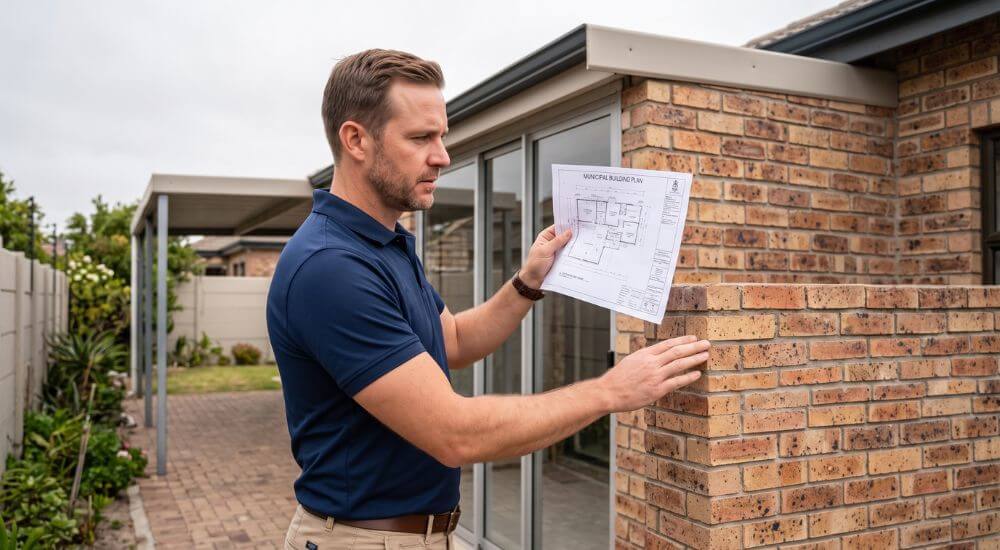
Selling a house with unapproved plans in Brackenfell can lead to bond rejections, forced demolitions, and a stalled transfer, no matter how good the property looks.
This is the biggest hidden risk in Protea Hoogte, where decades of carports, enclosed patios, and boundary wall extensions have gone up without anyone checking the paperwork.
Under the National Building Regulations Act and SANS 10400, any structural addition needs formal municipal approval before construction, not after.
That means proper plans, drawn up by a SACAP-registered professional and signed off by the local authority. Skip that step, and the structure is technically illegal.
The consequences are serious. Municipalities can fine owners or order demolition. Banks will not bond a property once their valuers spot unapproved work. The Deeds Office can block the transfer altogether.
The old voetstoots clause offers less protection than it used to, since buyers now commonly bring in inspectors and demand approved plans as a condition of sale.
If your home has unapproved additions, a proper valuation must subtract the cost of fixing it, a draughtsperson, penalty fees, possibly physical changes to meet SANS 10400.
That cost comes off your price either way, whether you disclose it or a buyer’s inspector finds it first.
The Comprehensive Valuation Protocol for Real Estate Practitioners
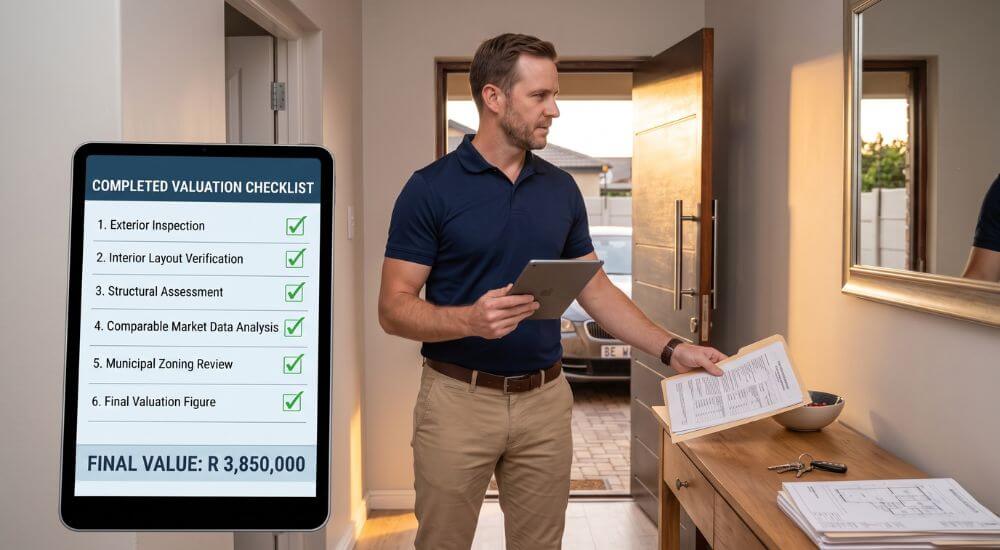
A proper valuation in Protea Hoogte follows six steps, starting with deeds registry data and ending with a physical walkthrough.
- Macro-Data Baseline. Pull deeds registry data for the street and property type to set the outer price ceiling.
- Structural and Geological Audit. Check for clay soil damage: stepping cracks, sinking paving, leaning walls. Settlement pulls the valuation down.
- Utility vs. Liability Check. Confirm SSEG registration on solar. Treat the pool as a cost, not a bonus.
- Capitalization Review. Reward kitchens and bathrooms. Penalize converted garages and other changes that strip out utility.
- Psychological Walkthrough. Flag scuffed paint and worn fixtures, the small things that trigger big price deductions.
- Regulatory Check. Compare the built structure against approved plans. Any mismatch gets priced in as a compliance risk.
Conclusion
There is no shortcut to working out how to accurately value a house in Brackenfell Cape Town, and Protea Hoogte proves it.
A Lightstone report can give you a starting number, but it cannot see the clay damage behind your wall, the unregistered solar on your roof, or the neighbour’s carport built without a plan.
Getting this right means treating your home as a collection of parts, each worth something different. A renovated kitchen adds real money. A pool usually does not.
Fresh paint defends your price more than most owners realize, and an unapproved structure can cost you a sale you thought was done.
If you are selling in Protea Hoogte, do not settle for a number from a computer that has never seen your home.
Get someone who knows the soil, the schools, the buyers, and the paperwork to walk through your property and give you a number you can trust.
About the Author
Andre Swart is a respected leader in Brackenfell real estate with over 20 years of results-driven experience. Through his platform, “Andre Swart Inspires,” he moves beyond simple property sales to share the proven mindset, strategies, and habits that build lasting success.
Grounded in integrity, Andre’s mission is to mentor the next generation of top agents and provide homeowners with the trusted guidance they deserve.