
Cape Town 183-Day Rule Short-Term Letting: Airbnb or Long Lease?
Proposed rates could add R29,700 a year to a R3.0m Airbnb. Weigh it against Northern Suburbs yields before 1 July 2027.

You bought a flat in Cape Town to earn from it. The Airbnb bookings came in. So did the cleaning bills, the levies, and the late-night guest messages. It was work, but it paid.
Now the City wants to change how it rates your property. The Cape Town 183-day rule short-term letting debate comes down to one number:50% of the year. According to the City of Cape Town draft by-law, a home made available for more than that would be rated as commercial. Public comment closes on 5 October 2026.
So the real question is simple. Do you keep the Airbnb, or sign a long lease? Let's look at the numbers.
Disclosure: Andre Swart is a partner in Alexander Swart Property Group, which is quoted in this article. Figures attributed to the firm are its own.
How the 183-Day Rule Works
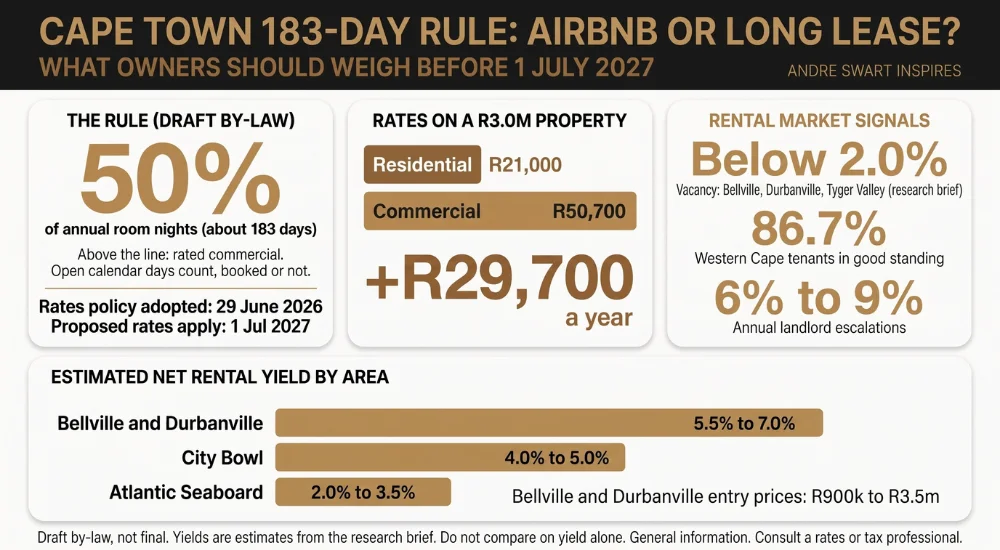
The proposed rule would rate a home as commercial if it is made available for short-term letting for more than 50% of annual room nights, which is about 183 days.
According to the City of Cape Town draft by-law, read together with the updated Municipal Rates Policy, a property at or below that line keeps its residential rating. The rates policy, adopted on 29 June 2026, already defines the 50% test. The Cape Town Airbnb by-law itself is still a draft.What the 183 Days Measure
The test counts the days your property is available, not the days it is booked. According to the research brief, the City would judge your status on calendar availability: the days you list or advertise on booking platforms. An open calendar day counts toward the limit even if no guest stays.
The count runs on room nights. That means bedrooms available multiplied by nights, measured over 365 days. If your calendar is open, the clock is running.
What the Commercial Rate Would Cost
According to TygerBurger, quoting Rowan Alexander, managing director of Alexander Swart Property Group, a R3.0m property would move from about R21,000 a year in residential rates to roughly R50,700 as a commercial property.
That is about 2.4 times the residential bill, a surcharge of R29,700 a year. Cape Town Airbnb commercial property rates would match what hotels and guesthouses pay.- R3.0m property: about R21,000 to about R50,700 a year.
- R5.0m CBD property: R33,155 to R77,910 a year, an extra R44,755 (calculated in the research brief from the proposed rate ratios, not independently verified).
According to TygerBurger, commercial rates are expected to take effect from 1 July 2027 through the first supplementary valuations process, once a property exceeds the 50% threshold in any 365-day rolling period.
Registration and Listing Rules
Every short-term rental would have to register with the City and display its registration number on every listing. According to the draft by-law, platforms such as Airbnb, LekkeSlaap and Booking.com would have to remove unregistered or cancelled listings within 10 working days.
They would also have to share the property address, municipal account and occupancy data with the City. That is the full mechanism: a number, a calendar and a rates bill that depends on both.Where Critics See Gaps
Critics say the draft by-law has gaps in how it counts availability and in who may let a home. You will hear these called Cape Town short-term letting by-law loopholes. They are critics' readings of the draft, not City positions, and the final by-law may change.
The Peak-Season Pattern
Critics note that a host who lists only from October to March would stay under the 183-day line. According to the research brief, that season runs 182 days, or 49.9% of the year. On the draft wording, a calendar closed for the other six months would keep the residential rating.
This is a reading of the text, not a plan to follow. The City could tighten the test before it adopts the final by-law, and any calendar pattern would be judged under that final text.
No Primary-Residence Requirement
The draft by-law does not require a host to live in the home they let. According to the research brief, Inside Airbnb names four policy pillars: mandatory registration, platform data sharing, removal of unregistered listings and a primary-residence requirement. The draft has the first three. It leaves out the fourth.
For comparison, a GroundUp op-ed notes that Vancouver restricted short-term letting to a host's principal residence in 2018, and that British Columbia extended the policy province-wide in 2024.
Why the City Is Proposing the Change
According to TygerBurger, the draft reportedly stemmed from concerns raised by hotel investors, who struggled to justify new developments while short-term rental operators paid only residential rates.
Mayco member for finance Siseko Mbandezi said the City believes the playing field should be equal, with all businesses using a property for commercial accommodation paying the correct rates.
That is the case for the rates change. Owners have to weigh it against the extra cost, which the last section covers.
The Housing Context
The by-law debate sits inside a housing question: how many Cape Town homes serve visitors instead of residents. This section gives the figures as the sources state them.
According to the City of Cape Town's Inner City Local Spatial Development Framework, as quoted in a GroundUp op-ed, only 30% of apartments or houses in the inner city are available for long-term leases or occupied by their owners. The remainder are hotel managed or listed on Airbnb.
According to Inside Airbnb data cited by GroundUp, Cape Town has more than 27,000 Airbnb listings, and about 84% are entire dwellings.
The op-ed, by a member of the Rent Control Group, makes a supply argument. By its figures, about 23,000 existing homes operate as Airbnb listings, against a City affordable housing pipeline of 14,000 units that remain largely unfunded and unbuilt.
The author says new homes take about a decade to deliver, while enforcing short-term letting rules is something policymakers can do now.
The op-ed also proposes ringfencing revenue from the by-law to fund affordable housing. This is the author's proposal, not a provision of the draft by-law.
The research brief does not place it in the draft by-law.Northern Suburbs Rental Yields

Northern Suburbs rental yields in Bellville and Durbanville are estimated at 5.5% to 7.0% net, against 2.0% to 3.5% on the Atlantic Seaboard and 4.0% to 5.0% in the City Bowl. Entry prices are lower in the Northern Suburbs (R900k to R3.5m). These are estimates from the research brief, not guarantees.
How the Yields Compare
Bellville and Durbanville show the highest estimated yields of the three areas in the research brief. The table compares gross with gross and net with net.
↔ Swipe table to view all data
| Area | Entry price | Gross yield (estimated) | Net yield (estimated) |
|---|---|---|---|
| Atlantic Seaboard | R3.5m to R10m+ | 2.5% to 4.5% | 2.0% to 3.5% |
| City Bowl | R2.0m to R5.0m | 5.0% to 6.5% | 4.0% to 5.0% |
| Bellville and Durbanville | R900k to R3.5m | 7.0% to 11.0% | 5.5% to 7.0% |
For anyone looking at Bellville property investment net yields, the estimated range is 5.5% to 7.0%. The best net figure in the other two areas is 5.0% (City Bowl).
The table groups Durbanville with Bellville, so the same 5.5% to 7.0% range applies to Durbanville buy-to-let rental yield.
Vacancy and Tenant Strength

Vacancy in the Northern Suburbs is low. According to the research brief, Western Cape vacancy hit a record low of 1.07% in late 2024. That is a provincial figure, not a Northern Suburbs one. The brief puts Bellville, Durbanville and Tyger Valley below 2.0%.
According to TPN Credit Bureau data cited by Bizcommunity in July 2024, 86.7% of Western Cape tenants were in good standing as of Q4 2023. The research brief estimates annual landlord escalations of 6% to 9%, with no named source.
What Drives Demand
Demand in the Northern Suburbs comes from business, medical and academic visitors. According to the research brief, three groups anchor it:
- Business: the Tyger Valley corporate hub, where office vacancy is 6.3%, a 15-year low.
- Medical: stays linked to Tygerberg, Karl Bremer and Louis Leipoldt Medi-Clinic.
- Academic and leisure: Stellenbosch Business School and Winelands tourism.
Durbanville Semigration
Durbanville is the most consistent relocation destination in Cape Town, according to Cape Removals booking logs cited in the research brief. Its market share is rising among incoming semigrants from Gauteng and KZN, and among local movers.
That supports Durbanville semigration rental demand as a theme. The logs record moves, not leases, so read them as a sign of demand, not a measure of it.Groot Phesantekraal
According to Rowan Alexander, managing director of Alexander Swart Property Group (Andre Swart's firm), speaking to Bizcommunity in July 2024, landlords at Wheatfields Estate in Groot Phesantekraal saw rental returns of 8.2% in year one and 9.1% in year two, with capital appreciation of around 8.5% a year.
Homes there were priced between R3m and R4m. These are one firm's figures for one development, so treat them as indicative.What Owners Should Weigh

The Airbnb vs long-term rental Cape Town decision comes down to one comparison: the extra rates bill under the proposed rules against what a long-term lease would earn.
The answer will differ by property. Cape Town commercial rate reclassification for Airbnb hosts is the main cost in that sum, and the by-law is still a draft.Short-Term Letting Under the Proposed Rates
A host above the 50% line would pay the commercial tariff, about 2.4 times the residential bill on the R3.0m example, an extra R29,700 a year.
A host below the line keeps the residential rating but would still have to register and display a registration number. Because the City would count open calendar days, a host would need to track availability, not just bookings.Long-Term Letting
According to TygerBurger, a property let long-term as a tenant's primary residence, for example on a year-long lease, would not be liable for commercial rates. According to the research brief, vacancy in Bellville, Durbanville and Tyger Valley is below 2.0%. The 86.7% good-standing figure above dates from Q4 2023.
Questions to Ask Before Deciding
Three questions help frame the choice:
- Would my calendar sit above or below 50% of room nights?
- Can my expected income carry the commercial surcharge, if it applies?
- What if the final by-law changes the test?
This article is general information. Consult a rates or tax professional before you decide.
Sources and Notes
"The research brief" means a market research summary compiled by Andre Swart Inspires for this article. Figures labelled estimated or attributed to the brief have no named primary source and should be treated as indicative.
- TygerBurger: Clock ticking on Cape Town's short-term letting by-law as hosts face commercial rates (30 September 2026)
- GroundUp op-ed in Daily Maverick: Airbnb bylaw doesn't do enough to address Cape Town's housing crisis (1 October 2026), by a Rent Control Group member
- Bizcommunity: Cape Town's Northern Suburbs faces rental-market squeeze (10 July 2024)
- City of Cape Town draft Short-Term Letting By-law and Municipal Rates Policy
Three figures in this article were stated by Rowan Alexander of Alexander Swart Property Group, of which Andre Swart is a partner: the R3.0m rates example, the Wheatfields Estate returns, and the 86.7% tenant good-standing rate (which he attributed to TPN Credit Bureau).
The by-law mechanics come from TygerBurger, and the housing figures from a GroundUp op-ed.Yield, vacancy and relocation figures are market estimates and may change. This article is general information, not financial, rates or tax advice.
Frequently Asked Questions
The 183-day rule is the proposed test that would rate a short-term rental as commercial if it is made available for more than 50% of annual room nights, which is about 183 days. According to the City of Cape Town draft by-law, the City would count days listed or advertised on booking platforms, not days booked. A home at or below the line would keep its residential rating. The by-law is still a draft, and the final text may change.
According to the research brief, the proposed commercial rate changes would take effect on 1 July 2027 through supplementary valuations, pending final public comment. Public comment on the draft by-law closes on 5 October 2026. The rates policy adopted on 29 June 2026 already defines the 50% test.
According to the research brief, estimated gross yields in Bellville and Durbanville run from 7.0% to 11.0%, and estimated net yields from 5.5% to 7.0%. The brief puts Atlantic Seaboard net yields at 2.0% to 3.5% and City Bowl net yields at 4.0% to 5.0%. The brief names no source for these ranges, and it does not say whether they reflect long-term or short-term letting.
Weighing your options as a property owner or investor in the Northern Suburbs?
Speak to Andre Swart for market data on your area.
Get Your Valuation