
Downsizing Your Home in Brackenfell: A Financial Guide for Seniors
When downsizing your home in Brackenfell in 2026, seniors should focus on three things: protecting their equity, understanding the capital gains tax exemption, and choosing an agent who manages the emotional side of the move, not just the transaction.

Hettie stood in the kitchen where she raised three children, looking at moving boxes she wasn’t ready to fill. Her Brackenfell home was paid off decades ago, but the rates bill kept climbing, the garden had become too much, and every room reminded her of a life she wasn’t ready to leave behind.
She is not alone. Across Brackenfell, seniors face the same quiet math: a home full of memories, a fixed income that cannot keep up with rising costs, and no clear plan for what comes next.
Downsizing your home in Brackenfell does not have to feel like losing everything you built. With the right numbers and the right best real estate agent in Brackenfell at your side, it can mean stepping into your next chapter with your equity protected and your dignity intact.
This guide walks you through exactly how.
The Financial Reality of Selling a Family Home for Retirement

Selling a family home for retirement comes down to one number: how much of your final sale price actually lands in your pocket once the costs are taken out.
That number is often smaller than sellers expect, and every Rand lost along the way is a Rand pulled straight out of your retirement fund.
The biggest cost most sellers overlook is the one they assume is fixed: agent commission. The standard rate in South Africa sits between 5% and 7.5%, plus VAT.
What many homeowners do not realize is that this fee is fully negotiable and is not set by law.
On an average Brackenfell home worth R1.8 million, negotiating commission down from 7.5% to 5% puts an extra R51,750 back in your pocket.
That is not a small saving. For someone relying on this sale to fund the next twenty years, it matters.
Legal fees work the same way. Instead of accepting a variable rate from your conveyancer, ask for a fixed-fee package.
Some Cape Town firms offer all-inclusive pricing, for example R30,000 for properties up to R2 million, which protects you from surprise charges for postage or FICA checks later in the process.
Then there is a cost specific to this city: compliance certificates. Before your transfer can register, you must provide certificates covering electrical compliance, gas (if applicable), electric fencing (if applicable), beetle clearance, and water installation.
The real risk here is not the inspection fee. It is what happens if your home fails one of these checks. A leaking toilet or an old showerhead can trigger unplanned repair costs at the worst possible time, right when you thought the sale was nearly done.
A rushed sale skips all of this. It accepts the first commission rate offered, the first quote from a conveyancer, and hopes the compliance certificates pass without a fight.
A properly managed sale checks every one of these costs before you sign anything, because none of them are fixed, and all of them affect what you walk away with.
Navigating Capital Gains Tax When Downsizing
Capital gains tax when downsizing is calculated on the profit you made above your original purchase price, and the first R3 million of that profit is excluded if the home was your primary residence.
This exclusion increased from R2 million as part of the 2026 Budget, and it applies to sales concluded from 1 March 2026 onward.
If your sale agreement was signed before that date, the older R2 million exclusion still applies, so the exact timing of your transaction matters.
Here is how it works in practice. Say your home sells for a profit of R2.5 million above what you originally paid for it.
Under the current R3 million exclusion, that entire profit falls within the tax-free threshold, and you owe nothing in capital gains tax. Under the older R2 million rule, R500,000 of that same profit would have been taxable.
This is general information, not personal tax advice. Your exact position depends on how the property was used, whether it was jointly owned, and other details specific to your situation.
Before you rely on any number, sit down with a tax practitioner or check directly with SARS to confirm what applies to you.
Cutting Your Costs Before You Sell: Rates Relief for Brackenfell Seniors

Rates relief for Brackenfell seniors starts with the City of Cape Town’s pensioner rebate, a sliding-scale discount on your monthly property rates.
It is based on two things: your age and your household income. Most eligible homeowners never claim it, simply because they don’t know it exists.
The CoCT Pensioner Rates Rebate
This rebate is the single most useful tool available to you right now. It applies if you are 60 or older. The size of your discount depends on your total gross monthly household income.
The scale works like this:
- R0 to R7,500 per month: you qualify for a full 100% rebate
- R7,501 to R22,000 per month: you qualify for a rebate of 10% to 90%, on a sliding scale
This can save you thousands of Rand a year. But it is not automatic. You must apply for it yourself.
Get the application form from the City of Cape Town’s website, or from a municipal Walk-in Centre. You will need a certified ID copy. You will also need proof of income and recent bank statements.
This is one of the simplest, highest-impact steps you can take before you even think about selling.
Why SASSA and FLISP Likely Won’t Help
Many seniors ask about the SASSA Older Persons’ Grant. For most Brackenfell homeowners, it will not apply.
The grant uses a strict means test. This includes a cap on your total assets. For a single person, that cap sits at R1,227,600.
Here is the problem. The average freestanding home in Brackenfell is worth well over R1.795 million. You must declare your home’s value when you apply. That alone will likely disqualify you.
First Home Finance, once known as FLISP, will not help either. This subsidy is built for first-time buyers only. The rule is simple: you must never have owned property before.
Your best move is the pensioner rebate. It looks at your income, not your assets, which makes it the right fit for a homeowner in your position.
Funding Pre-Sale Repairs Without Draining Your Savings
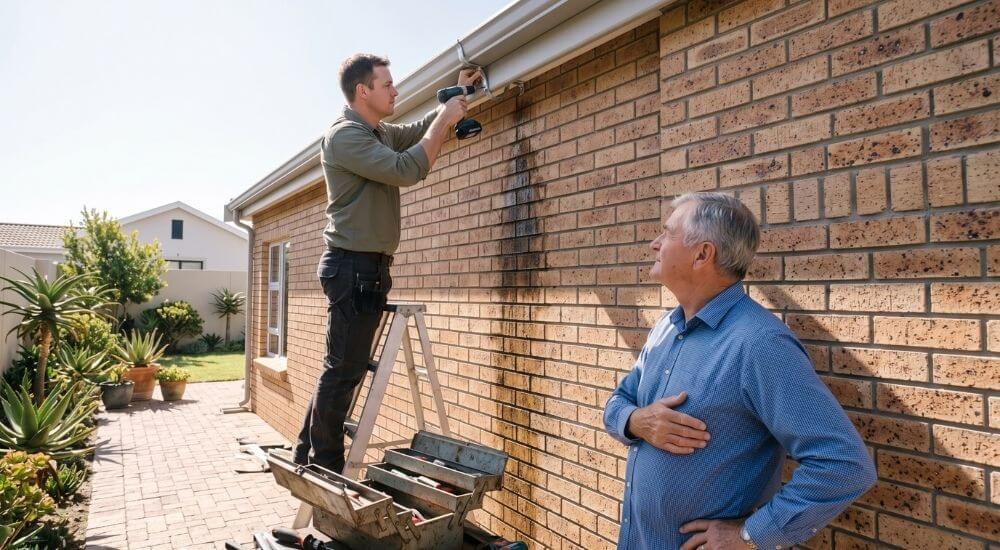
Funding pre-sale repairs without draining your savings comes down to two borrowing options, each suited to a different age and situation.
A home that needs visible repairs hands buyers leverage. A leaking gutter or a faulty plug can cost you tens of thousands off your asking price in negotiation.
Option 1: Pension-Backed Home Improvement Loans
This option suits homeowners aged 55 to 65 who are still employed. It also works if your pension fund was recently activated.
The Pension Funds Act allows this. You can borrow against your retirement savings specifically for home improvements.
This is not a general loan. It is a formal three-way agreement between your pension fund, your employer, and a financial provider.
The upside: your own savings secure the loan. The catch: it must be repaid by your fund’s normal retirement age, which limits it to earlier-stage seniors.
Option 2: Equity Release as a Short-Term Bridge, Not an Income Solution
For homeowners over 65, equity release, also called a reverse mortgage, is available. It lets you borrow against your home’s value with no monthly repayments. The loan gets settled once you sell.
Let’s be direct about this: it is a high-cost, high-risk product. Setup costs and compounding interest, often around 14.5%, make it a poor long-term income solution.
Used differently, it becomes a smart, short-term tool. Take a small loan, say R50,000, for one purpose only: funding critical pre-sale repairs.
Use that money to fix electrical faults or waterproofing. That single fix can unlock R100,000 or more in extra sale price. Your conveyancer then settles the loan, plus six to twelve months of interest, straight from the sale proceeds.
That turns a risky product into a controlled, short-term bridge.
Hiring a Handyman Without Getting Exploited
Once you have the funds, a new risk appears: exploitation. Northern Suburbs community forums are full of warnings about poor workmanship and unreliable handyman services.
The fix is simple. Never hire an unvetted provider. Use a platform built for accountability instead.
The Home+ app, backed by Santam, is one example. Every provider on it must pass a criminal background check and submit proof of qualifications. That filters the risk out before it ever reaches your door.
Finding and Funding Your Next Home in Brackenfell
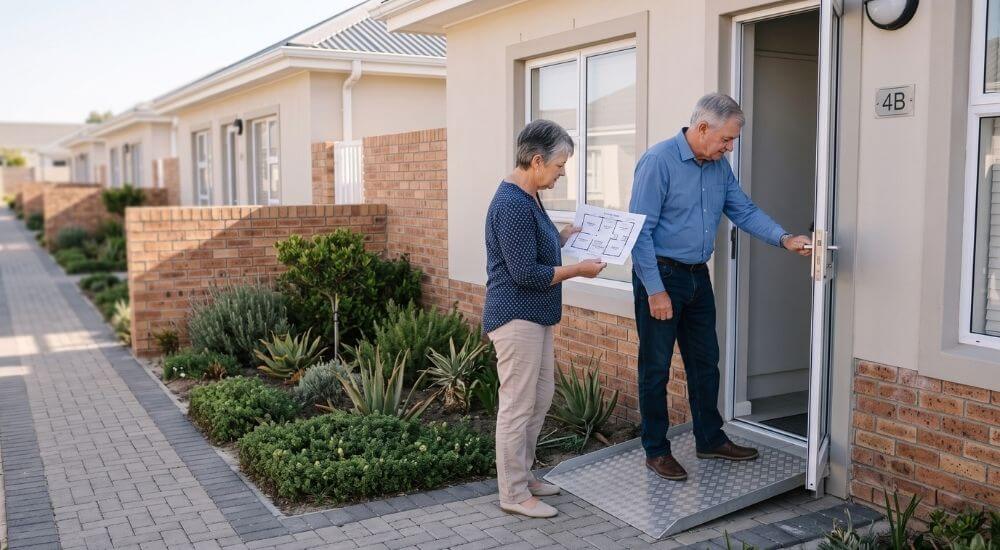
Finding and funding your next home in Brackenfell means weighing three things: what you can afford, what type of ownership suits your stage of life, and whether the home will still work for you in ten years.
Get any one of these wrong, and you risk another costly move down the line.
Local Affordable and Subsidised Housing Options
Social Housing is a real option if your household earns between R1,850 and R22,000 a month. It is aimed at exactly this income bracket, and it is worth checking even if you have some capital from your sale.
Locally, the City of Cape Town runs its own senior housing. Rusoord Cottages, on Bertrum Street in Brackenfell, is a direct, subsidised rental option worth looking into.
The “Downsize Premium” You Need to Budget For
Buying smaller does not always mean buying cheaper. A standard two-bedroom apartment in Brackenfell may cost R1.2 million. A similar two-bedroom unit in a local retirement village, like Paradys Park or Othello Village, can cost R1.5 million or more.
That extra R300,000 or more pays for security, frail-care access, and shared communal spaces. Before you commit, make sure your sale proceeds can cover both this premium and your ongoing living costs.
Life Rights vs Sectional Title: The Most Important Decision You’ll Make
Life Rights versus Sectional Title is a choice between risk and reward, and it is the single biggest financial decision in buying into a retirement village. Each path suits a different priority.
Sectional Title works like the ownership you already know. You hold full, registered title to the unit. You, or your heirs, keep 100% of any capital growth when it sells.
But you also carry every cost. Transfer duty, maintenance, and special levies all fall on you. A sudden R5 million roof repair could mean an unplanned R100,000 bill landing on your doorstep.
Life Right works differently. You buy a guaranteed right to live there for life. You never own the unit itself.
Because there is no property transfer, you pay no VAT, no transfer duty, and no capital gains tax. The developer stays the legal owner and covers all external maintenance and special levies, permanently.
Here is the trade-off. When your Life Right ends, your estate typically gets back only the original purchase price. There is no capital gain to pass on.
Think of a Life Right as longevity insurance. You give up future growth in exchange for total cost certainty for the rest of your life. For many seniors on a fixed income, that certainty is worth more than the upside.
A Universal Design Checklist for Your Next Home
Your next home needs to work for you now and in ten years, not just today. Moving into a home you’ll outgrow physically is a mistake that often forces a second, more expensive move.
Check for these features before you buy:
- Entry: Is there a no-step entrance into the home?
- Doorways: Are they at least 820mm wide? Standard 770mm doors are too narrow for a wheelchair.
- Bathrooms: Is there a curbless, walk-in shower?
- Handles: Are the door handles levers, not round knobs? Levers are far easier for arthritic hands.
A home that passes this checklist protects your independence, and your finances, for years to come.
Managing Your Move: Practical and Emotional Support for Seniors

Managing your move well means treating it as two separate jobs: the physical work of packing up a home, and the emotional weight of leaving one behind. Both matter. Neither should be rushed.
Hiring Professional Downsizing and Decluttering Services
Packing and sorting decades of belongings is real physical labour. For many seniors, that labour carries genuine health risk.
Treat professional help here as a health decision, not a luxury. Cape Town services like Absolutely Organised, Clutterfree, and So Sorted manage the full process for you.
They sort paperwork. They pack and unpack. They arrange donation or sale of anything you no longer need. One client put it simply: these services “take all the trauma out of moving.”
Support for a Difficult Transition
Leaving a family home can feel like a genuine loss. That feeling is valid, and you do not have to carry it alone.
Free support is available right now. The South African Depression and Anxiety Group (SADAG) runs a 24-hour helpline, including a dedicated suicide crisis line on 0800 567 567. They also run free support groups for grief and life transitions.
LifeLine Western Cape offers free counselling too, for anyone navigating a major life change.
Selling your home is a significant event. It does not have to become a crisis. With the right support around you, and the right plan for your finances, you stay in control of what happens next.
Why You Need a Specialized Real Estate Agent for Seniors in Brackenfell

A specialized real estate agent for seniors in Brackenfell is one who works around your timeline, protects your security during viewings, and negotiates your equity as if it were their own retirement on the line.
That is a different job than selling a home to a young family in a hurry, and it calls for a different kind of agent.
Most agents work on volume. More listings, more viewings, more closings each month, because that is how the industry measures success.
There is nothing wrong with that model for a buyer in their thirties who wants a quick, straightforward sale. But it is the wrong model for you.
Rushing a sale to hit a monthly target does not leave room to wait for the right buyer, negotiate patiently, or coordinate your move around a retirement village waiting list.
Security matters more here too. A public show house means strangers walking through your home unsupervised, sometimes fifty of them in a single afternoon.
For a senior living alone, that is not a minor inconvenience. It is a real risk, and it is one that a specialist agent plans around from the start, not something they think about only after something goes wrong.
Then there is the negotiation itself. An agent chasing a fast commission has every incentive to accept the first reasonable offer and move on to the next listing.
An agent who understands what this sale means for your retirement pushes back on lowball offers, because they know that every Rand negotiated is a Rand that funds the next twenty years of your life.
Before you sign a mandate, hold any agent you are considering up to these three standards. Three questions, three answers you can check against what you actually hear.
That is how you find someone who treats your sale as more than a transaction.
For more information, please read: How To Accurately Value a House in Brackenfell
← Swipe to see all criteria →
| What to Look For | Question to Ask Your Agent | Senior Specialist (Andre Swart) |
|---|---|---|
| Pacing & Transition | "How will you plan the timeline around my move?" | Aligns the sale with your retirement village or new home availability, not a monthly sales quota |
| Security & Viewings | "How will you manage viewings safely?" | Private, by-appointment viewings with financially pre-qualified buyers, not open show houses |
| Equity Defense | "What's your plan when a low offer comes in?" | A clear negotiation strategy aimed at maximizing your final retirement capital, not a quick close |
2026 Brackenfell Downsizing FAQ

This FAQ answers the two questions Brackenfell seniors ask most before they downsize: what they owe the taxman, and who they should trust with the sale itself.
Do I pay capital gains tax when selling my primary residence?
In most cases, no. If the profit on your primary residence falls under R3 million (for sales concluded from 1 March 2026 onward), the entire gain is excluded from capital gains tax. For sales concluded before that date, the older R2 million exclusion applies instead.
Say your home sells for a profit of R2.5 million above what you paid for it. Under the current R3 million exclusion, you owe nothing. Under the older R2 million rule, R500,000 of that profit would have been taxable.
The exclusion only applies to the home you actually live in, not a second property or holiday home. This is general guidance, not personal tax advice. Confirm your own position with a tax practitioner or SARS before you rely on any figure.
Who is the best real estate agent in Brackenfell for seniors?
The best real estate agent in Brackenfell for seniors is one who plans the sale around your timeline, protects your security during viewings, and negotiates hard to defend your retirement equity, not one chasing a quick commission.
Look for someone who treats your move as a financial and emotional transition, not just a transaction to close by month end.
As a best real estate agent in Brackenfell with over two decades in the Northern Suburbs, this is the exact standard I hold myself to with every senior client.
If you want a second opinion on your own situation, reach out for a confidential conversation.
Bringing It All Together: Your Next Chapter Starts Here

Downsizing your home in Brackenfell is not one decision. It’s a series of smaller ones, each one protecting a piece of your retirement. Claim your rates rebate. Fund repairs the smart way.
Understand what SARS actually takes. Choose an agent who treats your equity like their own. Pick a next home built for the next ten years, not just today. Ask for help with the move itself, both the boxes and the grief that comes with them.
Get each of these right, and the number that lands in your account reflects the true value of what you built, not what a rushed process left on the table.
If you are ready to see what your Brackenfell home is actually worth, and want a plan built around your timeline, not someone else’s monthly target, reach out for a confidential, no-obligation valuation.
Conclusion
Downsizing your home in Brackenfell touches every part of your financial life at once: your rates, your tax position, your next address, and your peace of mind.
None of it needs to be figured out alone, and none of it needs to be rushed.
Hettie’s story at the start of this guide is not unusual. What separates a senior who downsizes well from one who loses money on the process usually comes down to two things:
- Knowing which questions to ask.
- Having someone in your corner who answers them honestly.
You now have both. Claim what you’re owed, protect what you’ve built, and step into your next chapter on your own terms.
For more information, please read: How to Identify the Top Real Estate Agents in Brackenfell
About the Author
Andre Swart is a respected leader in Brackenfell real estate with over 20 years of results-driven experience. Through his platform, “Andre Swart Inspires,” he moves beyond simple property sales to share the proven mindset, strategies, and habits that build lasting success.
Grounded in integrity, Andre’s mission is to mentor the next generation of top agents and provide homeowners with the trusted guidance they deserve.