
Breaking the Real Estate Feast and Famine Cycle
Stop chasing deals. Start building a business.

There’s a familiar story that plays out across the Northern Suburbs. An agent closes a fantastic deal in Sonstraal Heights. The commission lands, and life feels secure.
There’s a celebratory lunch at Durbanville Hills, maybe even a weekend away in the winelands. The phone rings a few more times, but then… silence.
Days turn to weeks. No new mandates, no buyer inquiries, no transfer updates. The excitement fades, and the anxiety creeps in.
This is not a unique experience. It’s called the Feast and Famine Cycle, and it’s one of the most persistent threats to real estate agents in South Africa.
he highs are exhilarating, but the lows can leave even the most talented agents wondering whether they have what it takes to stay in the business long-term.
This is more than just an analysis; it’s essential real estate career advice for anyone committed to long-term success in our industry.
The Scale of the Problem

South Africa has approximately 46,000 recognised estate agents, according to the Estate Agency Affairs Board (EAAB). However, the numbers paint a sobering picture.
In 2024, only one-third of estate agents reached their volume and value targets. That leaves thousands of professionals navigating irregular income, emotional burnout, and long stretches without results.
In every town across the city — from Brackenfell to Kenridge — the same pattern plays out. A small group of agents earns the bulk of the commissions, while many others find themselves caught in a cycle of unpredictability.
The question is not whether the cycle exists, but what can be done to stop it from dictating your future.
Why This Cycle is Amplified in Our Market
In the Northern Suburbs, this feast-and-famine dynamic can be even more pronounced. The high demand driven by semigration and a reputation for excellent schools can create intense periods of activity, making it easy to believe the “feast” will last forever.
However, this same competitiveness means that when an agent neglects their pipeline, there are dozens of other disciplined professionals ready to fill that void.
Understanding how to manage this cycle isn’t just good practice here—it’s essential for survival and dominance.
What Is the Feast and Famine Cycle?
The feast and famine cycle is a recurring pattern in commission-based industries. Agents go through periods where business is thriving — listings are selling, buyers are active, and the bank account looks healthy.
This is the “feast.” Then, often without warning, a dry spell arrives. The phone stops ringing. Listings become scarce. Income drops sharply. This is the “famine.”
This pattern is common in real estate due to long transaction cycles, seasonal market shifts, and inconsistent prospecting habits.
An agent may close a large deal in March, but if they haven’t nurtured leads during that time, they may have no new mandates by June.
The Root Causes of the Feast and Famine Cycle

Financial Psychology and Commission-Based Income
Commission-based income can lead to distorted financial behaviour. When a large commission hits your account after a slow period, it’s natural to feel relief.
But many agents fall into reactive spending, focusing on short-term rewards rather than long-term planning.
Agents often experience:
- Immediate Gratification Bias – The need to reward yourself after weeks of financial pressure.
- Overconfidence Effect – Believing the next big sale is around the corner, even without leads in the pipeline.
- Loss Aversion – A fear of repeating lean months, which can lead to avoidance of prospecting and other income-producing activities during “busy” seasons.
This creates a loop where agents overspend during good months, underinvest in their business, and enter the next dry spell unprepared.
Inconsistent Pipeline Management
Every successful real estate career is built on a consistent stream of leads. But many agents shift into maintenance mode once a few deals start progressing.
Prospecting stops. Calls to homeowners are delayed. Networking events are skipped. As a result, the future pipeline dries up.
Lead generation in real estate requires long-term thinking. The person you chat with at a school rugby match in Brackenfell today might not be ready to sell until next year.
If you’re not consistently maintaining that connection, someone else will get the mandate when the time comes.
The majority of leads convert within 6 to 12 months. Without continuous engagement, agents set themselves up for future income gaps.
Lack of Business Systems and Structure
Many agents work reactively. There’s no written business plan, no lead nurturing process, and no calendar that reflects high-value tasks like follow-up calls or content creation. The absence of structure leads to unpredictability.
Agents who build systems tend to experience:
- More predictable income patterns
- Better control over time and tasks
- Increased professional confidence
Without a structured approach, agents operate based on emotion and energy levels, which leads to inconsistent output.
Financial Discipline Issues
A strong real estate career depends as much on how you manage your income as how you earn it. Agents who struggle financially tend to exhibit:
- Short-term focus – Making big purchases based on one successful month instead of building reserves.
- Lack of emergency funds – No financial buffer means agents feel pressure to close every deal, which can lead to desperation and poor client relationships.
- Debt dependency – Loans for vehicles, marketing campaigns, or even home upgrades create a burden when sales slow down.
It’s tempting to upgrade from a townhouse in Kraaifontein to a family home in Welgemoed, but a better move might be to allocate a portion of that commission to a six-month financial cushion — paying your “future self” first.
Prospecting Avoidance

You can be a great closer, a charismatic presenter, and an expert negotiator — but without consistent prospecting, your career remains unstable.
Problematic prospecting patterns include:
- Treating lead generation as optional
- Allowing fear of rejection to prevent follow-ups
- Giving up after one or two unsuccessful calls
- Failing to implement and maintain a database
Many agents still rely on referrals or friends and family, believing this proves they’re good at sales. In reality, the most reliable agents are the ones with systems in place for daily outreach.
Operational Weaknesses
Without digital systems and accountability structures, most agents default to survival mode. Critical tasks like database management, marketing automation, and performance tracking are left behind.
Some common signs of operational weakness include:
- No CRM system for follow-up
- Disorganized contact lists
- Poor tracking of leads and transactions
- Resistance to using technology to improve efficiency
Agents who work without accountability partners or mentors also risk falling back into comfort zones during tough times.
Solutions: How to Break the Cycle
Establish Financial Systems
A commission windfall should lead to strategy, not spending. Managing real estate commissions effectively starts with a powerful principle: creating a system that allocates every rand before it even hits your account. This is how you move from being reactive to being the CEO of your own career.
The most disciplined agents operate with two separate budgets—one for the business and one for personal life—to maintain absolute clarity. They use a percentage-based allocation rule to ensure that every commission serves their long-term vision.
While your exact percentages must be tailored to your specific situation, a powerful and common framework to use as a starting point looks like this:
- Taxes (e.g., 25-35%):
This portion is non-negotiable. It never truly belongs to you; you are just holding it for SARS. By setting it aside immediately, you eliminate future tax-season stress and crippling surprise bills.
- Business Reinvestment (e.g., 20-30%):
This is your growth fund. It covers your marketing, tech subscriptions (like your CRM), fuel, professional development, and branding costs. Consistently funding this account ensures you never have to stop marketing because of a slow month.
- Savings & Emergency Fund (e.g., 10-20%):
This is your stability fund—your defence against the “famine.” The goal is to build a reserve that can cover 3-6 months of both business and personal expenses. This fund is what allows you to make decisions from a position of strength, not desperation.
- Personal Income (The Remainder):
This is the money you use to pay yourself a “salary” and manage your personal household budget. It’s what you truly have available to live on after securing your business and your future.
A Crucial Note: These percentages are a guideline, not gospel. The most critical step you can take is to sit down with your accountant or a qualified financial advisor. They will help you determine the precise figures for your individual tax bracket and business model.
This structure isn’t about restriction; it’s about liberation. It removes financial anxiety, guarantees you always have capital to invest in growth, and provides the peace of mind needed to build a sustainable, profitable business.
Develop a Daily Prospecting Routine
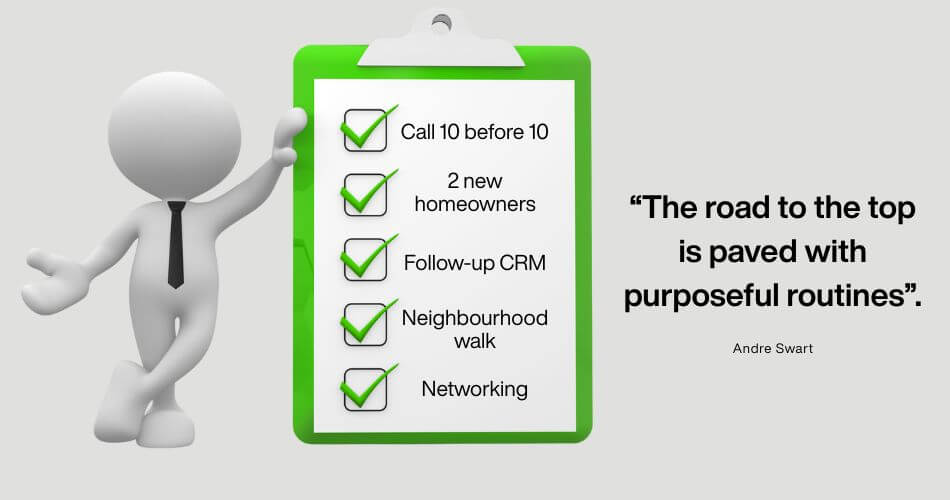
Consistency is the foundation of income stability. Some agents use the “10 before 10” rule — ten calls before 10 a.m. every weekday. Others block out two to four hours daily for lead generation.
Effective prospecting habits include:
- Reaching out to two new homeowners per day, five days a week
- Contacting 20 local businesses to understand their space needs
- Using time-blocking to dedicate focused effort to client outreach
Success in real estate stems from repetitive, intentional actions. These are the successful real estate habits that separate top performers from the rest.
Build and Maintain a CRM System
A CRM (Customer Relationship Management) system is essential for tracking conversations, follow-ups, and lead stages. When used properly, it becomes the heart of your business.
Key features to leverage:
- Automated follow-up sequences
- Contact notes and reminders
- Lead segmentation (hot, warm, cold)
- Email marketing integration
Your database should reflect every chat, coffee, and call with a potential client — even the friendly greeting at Checkers in Durbanville.
Adopt a Growth-Focused Mindset
Sustainable success comes from internal change. Implementation intentions — specific plans for when and how you’ll complete key tasks — lead to better follow-through.
Examples:
- “I will make 20 follow-up calls every Tuesday, Wednesday, and Thursday at 11 a.m. from the office.”
- “I will send two property updates per week to everyone in my pipeline.”
Growth-oriented agents attend industry training, join coaching programs, and seek feedback. They take ownership of both wins and losses.
The Path Forward: Thriving, Not Just Surviving, in the Northern Suburbs

The feast-and-famine cycle doesn’t define your career — it reflects your systems, your habits, and your willingness to take responsibility for the things that matter most.
In the Northern Suburbs, we are surrounded by opportunity. From the homes in Eversdal to the plots in Protea Heights, every listing started with a relationship.
Every transaction began with a conversation. Every thriving career was built on small, consistent steps — repeated without fail.
Agents who treat real estate as a business, who protect their income with financial wisdom, and who commit to daily prospecting habits will find that stability is not out of reach.
It’s created through discipline, planning, and follow-through.
There is no magic formula, but there is a better way forward. One where Northern Suburbs estate agents become known not only for their sales but for their reliability, professionalism, and long-term success.
By operating with intention… you position yourself for a career that grows year after year. These aren’t just Northern Suburbs real estate tips; they are the foundations of a lasting legacy.
About the Author
Andre Swart, director of Alexander Swart Property Group, is a respected figure in Brackenfell and Cape Town’s Northern Suburbs real estate scene, with over 20 years of hands-on experience. Known for his results-driven approach and uncompromising integrity, Andre empowers agents and sellers alike to rise above the ordinary.
Through his blog, Andre Swart Inspires, he shares real-world insights that go beyond property sales—focusing on mindset, discipline, and the habits that lead to long-term success. Grounded in ethical business practice and faith-based values, Andre’s mission is to help others build not just deals, but lasting legacies.
Whether you’re selling your home or building your career, Andre is here to challenge your thinking, elevate your standards, and support your growth—one step, one decision, and one habit at a time.