
The Inversion Mental Model for Business
The Art of Inversion: Why Top Agents in 2026 Will Win by Thinking Backwards
Stop studying success. The real secrets to dominating the Cape Town property market are hidden in the graveyard of your lost deals.

During World War II, the military faced a significant problem. Allied bombers were returning from combat missions riddled with bullet holes. To reduce casualties, commanders studied the damaged planes.
They mapped every hit. The wings and fuselage were often covered in shrapnel, while the cockpits and engines remained relatively clean.
The commanders reached a logical conclusion: they needed to reinforce the wings and fuselage.
Abraham Wald, a statistician, disagreed. He pointed out a flaw in their reasoning. The military was only looking at the planes that returned.
The damage to the wings was not fatal because those planes made it home. The planes hit in the cockpit or engines never returned to be counted. They were at the bottom of the ocean.
Wald argued they should reinforce the areas where there were no bullet holes. He used the inversion mental model for business and strategy to save lives.
By looking at what was missing, rather than what was present, he saw the truth.
The Fatal Flaw: Why You're Studying the Wrong Airplanes

The WWII Bomber Problem: The Deception of Survivor Bias
The story of Abraham Wald is not merely a history lesson; it is a direct critique of how most people approach their careers. The military commanders fell into a cognitive trap known as survivor bias.
They focused their attention entirely on the “survivors”—the data that was easily visible and available to them. It is intuitive to look at success and try to replicate it.
If a plane comes back with holes in the wings, you fix the wings. This linear thinking feels safe. It feels like progress. However, it is a deception.
By ignoring the “dead” planes, the commanders were blind to the actual cause of failure. They were about to add heavy armor to non-critical areas.
This would have made the planes slower, heavier, and less fuel-efficient, without solving the problem of why they were being shot down. In the high-stakes environment of war, this kind of flawed thinking is deadly.
In the high-stakes environment of the property market, it is merely expensive. It costs you growth. It costs you market share.
It keeps you working harder while achieving less because you are reinforcing the parts of your business that are already surviving.
Your 'Fatal Bullet Holes': Deconstructing the Deals You Lost
As a real estate agent, you likely suffer from the exact same bias as those military commanders. When you review your year, you inevitably look at your closed deals. You look at the mandates you signed.
You look at the commission that landed in your bank account. You ask yourself, “What did I do right to get this?”
You might conclude that your success came from your new brochure, your friendly demeanor, or your persistence. You then resolve to do more of those things in 2026. You are reinforcing the wings.
This is a mistake. The closed deals are the planes that came back. They survived your process. Whatever mistakes you made with them were not fatal.
The client might have been annoyed that you were late, but they still signed. Your valuation might have been slightly off, but the market corrected it. Studying your wins only tells you what didn’t kill the deal.
To understand how to dominate the market, you must look at the graveyard. You must study the deals that died. Look at the valuation presentation where you came second.
Look at the buyer who viewed three homes with you and then stopped replying to your messages. Look at the mandate that sat on the market for six months and expired unsold.
These are your planes at the bottom of the ocean. These losses contain the data you desperately need. The fatal bullet holes are here.
Perhaps you lost the valuation not because of your fee, but because you lacked market data. Perhaps the buyer ghosted you because you talked too much and listened too little.
Unless you study the dead deals, you will never find your true weaknesses.
Shifting Your Focus from 'What Works' to 'What Kills'
The shift from studying success to studying failure requires a radical change in perspective. It demands that you suppress your ego.
It is painful to look at losses. It is far more comfortable to celebrate wins. However, comfort is the enemy of improvement. In 2026, the market will not care about your comfort. It will punish your blind spots.
To apply survivor bias in business strategy correctly, you must stop asking “How do I succeed?” and start asking “Why did I fail?” When you identify the specific reason a client chose a competitor, you have found a cockpit hit.
If you realize that every mandate you took in a specific complex failed to sell, you have found an engine hit. Fixing these issues yields a far higher return on investment than polishing your strengths.
If you are excellent at negotiation but terrible at lead follow-up, getting better at negotiation will not help you. You will simply have fewer opportunities to negotiate.
You must reinforce the cockpit. You must fix the fatal flaws that prevent deals from ever reaching the closing table.
The 'Kill Your Business' Exercise: Your Blueprint for Avoiding Failure
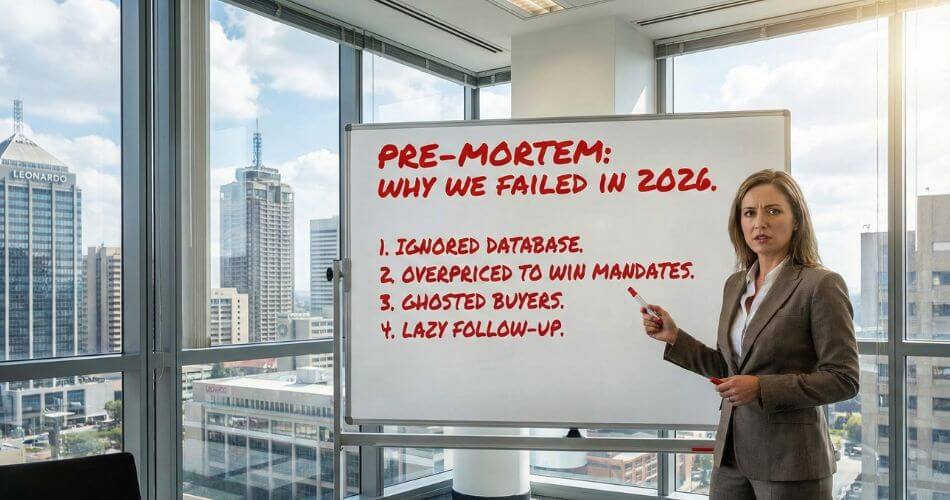
The Power of a 'Pre-Mortem' for Your Real Estate Career
Most business planning is optimistic fiction. Agents sit down in January and write, “I will sell 24 homes” or “I will earn R2 million in commission.” This is wishful thinking, not strategy.
It assumes a perfect world where interest rates are stable, buyers are plentiful, and you have endless energy. A superior approach is what is a failure pre-mortem.
This exercise, popularized by psychologists and strategists, does not ask you to imagine success. It asks you to imagine a catastrophe.
Imagine it is December 31, 2026. You are looking back at the year, and it has been a disaster. You sold zero homes. Your reputation is in tatters. Your bank account is empty. This is the premise of the pre-mortem.
Now, your task is to write the history of this disaster. You must detail exactly what actions, behaviors, and decisions led to this outcome. Did you stop prospecting in March because you got comfortable?
Did you overprice every listing just to win the mandate, leading to stagnation? Did you ignore your past clients?
By forcing your brain to explain a failure that has “already happened,” you bypass the optimism bias that usually clouds judgment. You see the risks clearly.
You identify the cliffs before you drive off them. This list of failures becomes the most important document on your desk.
Charlie Munger's Secret: Being 'Consistently Not Stupid'
The wisdom of Charlie Munger thinking backwards is simple yet profound. He often stated, “It is remarkable how much long-term advantage people like us have gotten by trying to be consistently not stupid, instead of trying to be very intelligent.”
In a complex field like real estate, brilliance is hard to reproduce. You cannot control luck, market timing, or the whims of a buyer. Relying on being a genius every day is a fragile strategy.
However, stupidity is easy to identify and easy to avoid. Stupidity in real estate looks like taking an overpriced mandate that you know will not sell. It looks like failing to return calls. It looks like arriving late to a viewing. It looks like spending three hours on social media instead of calling your database.
If you simply remove these behaviors, you automatically rise to the top. You do not need to be the smartest agent in the room. You just need to be the one who makes the fewest unforced errors.
Munger understood that in many games, the winner is not the person who hits the most winners, but the person who hits the fewest losers. Real estate is such a game.
Your 2026 Anti-Goals: A Practical Guide to Building Your Plan
Once you have your pre-mortem list, you can construct your strategy for 2026. Instead of a list of goals, create a list of “Anti-Goals.” These are the things you strictly promise not to do.
Standard goals are often vague. “Be a better communicator” is a weak goal. It is hard to measure. An Anti-Goal is sharp and actionable. “Never let a client call go unreturned for more than 2 hours” is a concrete rule.
If your pre-mortem revealed that you failed because you had no new leads, your Anti-Goal is: “Never end a week with zero new conversations.”
If you failed because you wasted time on unqualified buyers, your Anti-Goal is: “Never put a buyer in my car without a pre-qualification.” By following these rules, you protect your business from the specific causes of failure you identified.
You are not trying to be perfect; you are simply systematically closing the doors through which failure enters. This is how you build an indestructible business.
Inverting the Client Experience: The Power of Removing Annoyance

Why 'Delighting' Your Client Is a Vague and Useless Goal
The real estate industry is obsessed with the idea of “delighting” the client. Training sessions are filled with advice on how to go “above and beyond.” While well-intentioned, this advice is often useless. “Delight” is subjective.
What delights one person might annoy another. Furthermore, trying to delight a client is like trying to put icing on a cake that hasn’t been baked yet. If the core service is broken, no amount of gift baskets or champagne will fix it.
It is far more effective to invert the problem. Instead of asking “How can I thrill my client?”, ask “What enrages my client?”
People might disagree on what constitutes a perfect service, but they almost universally agree on what constitutes bad service. Nobody likes being lied to. Nobody likes being ignored. Nobody likes uncertainty.
A Checklist of Client 'Rage Points' to Eliminate
To build a reputation that withstands any market, you must ruthlessly eliminate the friction points that drive clients crazy. How to avoid common real estate agent mistakes starts with recognizing these rage points.
For sellers, the primary source of rage is silence. They hate being kept in the dark. They hate wondering if you are actually working. Another rage point is hearing excuses about the market instead of strategic solutions.
They hate being pressured to drop their price two weeks after you promised them a record sale. For buyers, the rage comes from inaccuracy and unavailability.
They hate agents who do not answer their phones. They hate listings with bad photos or no floor plans. They hate arriving at a show house that looks nothing like the pictures online.
If you simply eliminate these frustrations, you will stand out. You do not need to be charismatic. You do not need to drive a luxury car.
You just need to be the agent who always answers, always tells the truth, and never leaves a client guessing.
The Surprising ROI of Simply Not Being Annoying
There is a massive return on investment in simply not being annoying. When you remove the negatives, the positives shine brighter. A client who is never frustrated is a client who trusts you. Trust leads to referrals.
The bar for service in the real estate industry is often incredibly low. Most agents are disorganized, communicative only when it suits them, and focused on their own commission rather than the client’s needs.
By applying inversion, you realize that you don’t have to be a superhero. You just have to be reliable. If you want to be in the top 1% of the Northern Suburbs, you don’t need to reinvent the wheel.
You just need to systematically remove every single friction point that makes dealing with an agent painful. Be the path of least resistance.
In a chaotic world, the person who offers a smooth, frustration-free experience is the one who wins the business.
The Not-To-Do List: Achieving More by Doing Less

The Illusion of 'Hustle': Why Adding More Is Holding You Back
Modern hustle culture tells you that the answer to every problem is “more.” Do more marketing. Post more videos. Knock on more doors. Attend more networking events.
This leads to a frantic, scattered approach where you are a mile wide and an inch deep. You end up doing twenty things poorly instead of three things well. This is the illusion of hustle. Movement is not the same as progress.
Inversion teaches us that subtraction is often more powerful than addition. The best agents in 2026 will not be the ones who do the most; they will be the ones who do the least amount of stupid, wasteful activity. They will clear the decks to focus on what actually matters.
Identifying and Eliminating Your Time-Wasting Activities
To increase your productivity, you need a not-to-do list for productivity. You must audit your time with the same ruthlessness that you audited your failed deals.
Ask yourself: “What am I doing right now that is wasting my energy?” A prime candidate for the list is the “Hope Strategy”—working with overpriced sellers who are not motivated to sell.
You take the mandate, hoping the market will turn or they will see reason. They rarely do. This drains your resources and morale. Put it on the Not-To-Do list.
Another candidate is social media scrolling disguised as “market research.” Spending two hours watching other agents’ videos does not help you sell a house. It is procrastination.
Administrative tasks are another trap. If you are spending your prime selling hours designing flyers or filing paperwork, you are failing. These tasks should be delegated or automated.
The Power of Subtraction for Revenue-Generating Focus

When you strip away the busy work, the vanity metrics, and the dead-end clients, you are left with a void. This is good. This space allows you to focus entirely on revenue-generating activities: prospecting and negotiating.
Success in 2026 will come from deep focus on these core tasks.
Consider the context of the Northern Suburbs. Applying inversion to your daily logistics can save you hours. Instead of asking “How do I get to the office faster?”, ask “How can I organize my day so I never have to sit on the N1 during peak hour?” By subtracting the commute, you gain an hour of productivity.
Consider safety. Instead of asking “How do I stay safe?”, ask “What makes me a target?” Meeting strangers at empty properties alone makes you a target. By inverting the question, you establish a rule: never do a viewing without a colleague or a verified ID.
By removing the junk, the danger, and the waste from your schedule, you become a lean, effective operator. You become the plane that reinforces the cockpit.
The property market in 2026 will be challenging. It will chew up agents who rely on optimism and old habits. But you do not need to be a genius to succeed. You do not need to predict interest rates or have a magic script.
You just need to look at what fails and run in the opposite direction. Be the plane that reinforces the cockpit, not the wings.
Study the inversion mental model for business, create your not-to-do list, and dominate the market by simply thinking backwards.
About the Author
Andre Swart is a respected leader in Brackenfell real estate with over 20 years of results-driven experience. Through his platform, “Andre Swart Inspires,” he moves beyond simple property sales to share the proven mindset, strategies, and habits that build lasting success.
Grounded in integrity, Andre’s mission is to mentor the next generation of top agents and provide homeowners with the trusted guidance they deserve.