
Why Traditional Estate Agents Are Failing in 2026
The Great Displacement: 7 Reasons Why 'Local Experts' Are Facing Extinction in 2026
The ‘2026 Paradox’ is brutal: Your 20 years of experience is no longer an asset—it is the anchor dragging you under.

We are witnessing an extinction event. It is not being broadcast on the news, but it is happening in every boardroom and showhouse across the Northern Suburbs.
The veteran agent, the “Local Expert” who has dominated for two decades, is disappearing. Transaction volumes in areas like Haasendal are stabilizing, yet old-school agents are starving. This is the “2026 Paradox.”
The market has shifted beneath your feet. The tools that built your career; flyers, magnets, and handshake deals, are now the very things destroying it.
You are not losing business because the market is dead; you are losing because you are invisible to the new digital buyer.
This manifesto is a forensic audit of why traditional estate agents are failing in 2026. It is not a motivational speech. It is a survival guide.
We will dissect the economic forces, the behavioral traps, and the technological tsunamis that are wiping out the middle class of the property sector. Read this if you want to know if you will still be here in 2030.
Part 1: The Macro-Context – The K-Shaped Recovery and Regulatory Iron Cage

The K-Shaped Reality: Why Semigration is Leaving the 'Average' Agent Behind
The South African property market has emerged from the post-pandemic interest rate hikes, but it has not recovered evenly.
We are seeing a classic “K-Shaped Recovery.” The upper arm of the K represents the wealthy and the semigrants.
These buyers are flooding into the Western Cape, fleeing the instability of Gauteng. They are buying in security estates and high-growth nodes.
The lower arm of the K represents the traditional middle class. These buyers are battered by inflation, debt, and the cost of living. They are stagnant.
If your entire business model is built on servicing this struggling middle market using traditional methods, you are sinking with them. The liquidity is at the top, but the top is demanding a different kind of service.
This split explains why some agents are having their best year ever, while you are having your worst. The “Semigrant” from Sandton does not care about your local reputation from 2010. They care about digital efficiency.
They are spending millions, and they expect a “First World” transaction experience. If you cannot provide that because you are stuck in “Third World” analog processes, you are cut out of the deal before you even know it exists.
The PPA Crush: How Regulatory Costs are Killing the Mom-and-Pop Agency
The Property Practitioners Act (PPA) is no longer a new piece of legislation; it is fully mature, and it is acting as a “Regulatory Iron Cage.” The cost of compliance has skyrocketed.
Maintaining trust accounts, paying for audits, and managing the relentless Fidelity Fund Certificate (FFC) requirements now consume up to 15% of a small agency’s budget.
For the solo agent or the small “mom and pop” shop in Brackenfell, this property practitioner’s compliance burden is catastrophic. In the past, you could survive on a few deals a year.
The low overheads allowed you to coast. Today, the fixed costs of simply being legal mean you need volume to survive.
The PPA was designed to professionalize the industry, but its side effect has been to punish the small player. It favors the large, tech-enabled brokerages that can automate their compliance.
If you are still trying to manage your FICA documents in a physical file cabinet, you are paying a “Time Tax” that your digital competitors are not. You are drowning in paperwork while they are closing deals.
The Rise of Platform Natives: Meeting the Demands of the New Brackenfell Buyer
The demographic of your buyer has changed. In 2016, the typical Brackenfell buyer might have been a local looking to upgrade. In 2026, the buyer is a “Platform Native.”
This is a 35-year-old remote worker or investor who manages their entire life through apps. They order groceries on Checkers Sixty60. They bank on Capitec’s app.
They expect their property transaction to be just as seamless. When they encounter an agent who insists on phone calls between 9 and 5, or who cannot send a digital brochure instantly via WhatsApp, they experience “Friction.” To a Platform Native, friction is a signal of incompetence.
These buyers do not trust a “Sold” board on a lawn. They trust digital authority. They look for Google Reviews, LinkedIn articles, and high-definition video tours.
If you are not present on these platforms, you are invisible. You are trying to sell an analog service to a digital consumer. The mismatch is fatal.
Part 2: The Behavioral Trap – When Experience Becomes a Liability

The Competency Trap: Why We Double Down on Methods That No Longer Work
You have likely heard colleagues say, “I’ve been doing this for 20 years, I know what works.” This attitude is the single biggest danger to your career.
Behavioral economists call it the competency trap in real estate sales. It happens when you are highly skilled at an obsolete task.
You are good at dropping flyers. You are good at cold calling. Because you are good at it, you keep doing it. You get a small dopamine hit from the activity itself.
But the market has moved on. The return on investment for these activities has collapsed.
Instead of changing your method, you double down. You print more flyers. You make more calls. You work harder than ever, but your results keep declining.
You are caught in a feedback loop of “Success to the Successful”—doing what used to make you successful, even though it now guarantees failure. You are digging your own grave with the shovel of your experience.
System 1 Laziness: The Biological Refusal to Learn AI
Why is it so hard to switch to new tools? It is biology. Your brain operates on two systems. System 1 is fast, intuitive, and easy.
For you, traditional prospecting is System 1. You can do it in your sleep. System 2 is slow, logical, and hard. Learning to use Artificial Intelligence (AI) requires System 2 thinking.
It is mentally exhausting to learn how to prompt ChatGPT or analyze data. Your brain is an energy-conserving organ. It naturally resists this effort.
It wants to stay in the comfortable lane of System 1. You rationalize this laziness by saying, “I’m a people person, not a tech person.”
This is a lie you tell yourself to avoid the pain of learning. The “biological refusal” to rewire your neural pathways is what keeps you poor.
While you are protecting your energy, your competitors are building automated systems that will replace you.
Sunk Cost Fallacy: Why You Won't Pivot from 'People Skills' to Data Skills
You have spent decades building a network based on face-to-face interaction. You view this network as a massive asset. To pivot to digital marketing feels like throwing that asset away. This is the “Sunk Cost Fallacy.”
You are clinging to a depreciating asset (your analog network) while refusing to invest in an appreciating asset (your digital data).
You believe that real estate is purely a “people business.” You use this as a shield against technology. But in 2026, real estate is a “data business” first, and a “people business” second.
You cannot get to the people if you do not understand the data that finds them.
By refusing to pivot, you are rendering your “people skills” useless because you have no people to talk to. The algorithm has intercepted them before they ever reach your showhouse. You are the best negotiator in an empty room.
Part 3: The Marketing Autopsy – The Mathematical Death of the Flyer
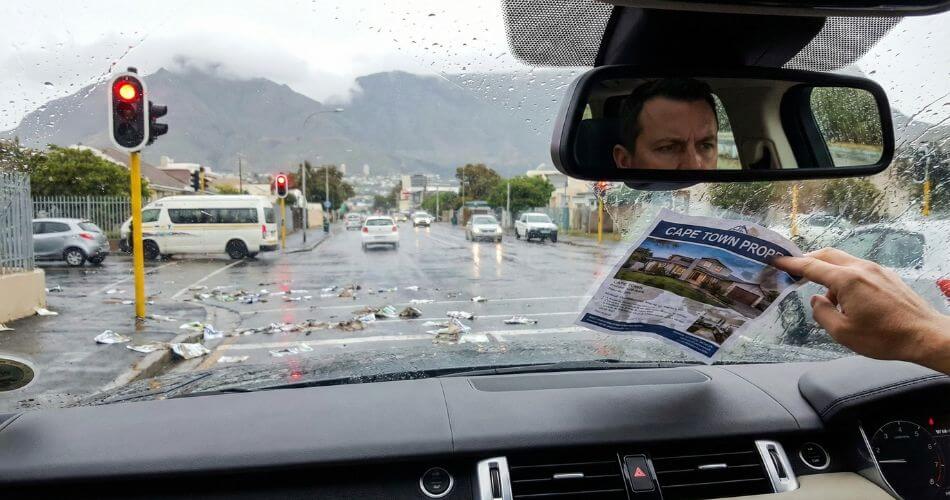
The ROI of Waste: Why 'Spray and Pray' at Robots is Bankrupting You
Let us look at the math. Agents in the Northern Suburbs are still paying thousands of Rands to print flyers and pay distributors to hand them out at robots (traffic lights).
This is “Spray and Pray” marketing. It targets a geographic coordinate, not a buyer intent.
You are handing a flyer to everyone: people who just bought, people who are renting, people who live in a different suburb. The wastage is massive. Compare this to real estate marketing ideas that work in 2026.
Digital marketing allows you to target behavior. You can place an ad specifically in front of someone who searched for “3 bedroom house in Haasendal” yesterday.
The cost per lead on a flyer is astronomical compared to a targeted Facebook or Google ad. You are literally throwing money into the gutter.
It is not an investment; it is a vanity project to make you feel like you are “working.”
Physical Media Blindness: To the Modern Buyer, Your Flyer is Just Litter
It gets worse. Drivers have developed “Physical Media Blindness.” Just as we learned to ignore banner ads on websites, we now ignore paper at intersections.
Most people see a flyer distributor as a nuisance. They roll up their windows. They are worried about “Smash-and-Grabs.”
If they do take the flyer, it is often out of pity, and it ends up in the trash bin of the car. But here is the critical point: The modern consumer values sustainability.
When they see you generating mass paper waste, it damages your brand.
Your face on a discarded flyer in the mud does not signal “Success.” It signals “Desperation.” It tells the buyer that you are stuck in the past. You are marketing your own obsolescence.
Digital Invisibility: If the Algorithm Can't Read You, You Don't Exist
The final nail in the coffin of the flyer is that it is invisible to AI.
When a buyer asks their AI assistant to “Find the best agent in Brackenfell,” the AI scans the internet. It reads reviews, blog articles, watches video transcripts, and analyzes social media engagement.
It cannot read a piece of paper in a dustbin. By spending your budget on physical media, you are starving your digital presence. You are not feeding the algorithm. Therefore, the algorithm will not recommend you.
You are effectively a ghost. You exist in the physical world, but you do not exist in the digital world where 99% of the search activity happens. In the economy of 2026, if you are not indexed, you are extinct.
Part 4: Digital Darwinism – Predator vs. Prey in the Algorithm Age

The Bifurcation: The Gap Between the Digital Predator and Analog Prey
The market is splitting into two distinct species. We have the “Digital Predator,” agile, data-driven, and AI-integrated. And we have the “Analog Prey,” slow, intuition-based, and dependent on legacy methods.
This is Digital Darwinism. The environment has changed to favor the digital organism. The Predator does not just compete with you; it consumes your food source before you even wake up.
They use predictive analytics to identify sellers months before those sellers call an agent.
By the time you get the call (if you get it), the Predator has already nurtured the lead with automated content, market reports, and virtual tours. You are fighting for scraps while they feast on the main course.
The AI Proficiency Crisis: The 'Arbitrage of Incompetence' in the Industry
The AI Proficiency Crisis: The ‘Arbitrage of Incompetence’ in the Industry
There is a massive “Arbitrage of Incompetence” in the industry right now. A tiny fraction of agents, less than 1%, are truly proficient in using Agentic AI to automate their workflows.
The rest are stuck in the “Pilot Trap,” using AI just to write a bio or a funny caption.
The question, will AI replace estate agents in South Africa is the wrong question. AI will not replace agents. Agents who use AI will replace agents who do not.
The proficient agent can do the work of ten traditional agents. They can analyze pricing trends in seconds. They can personalize communication to 500 people simultaneously.
This efficiency gap is insurmountable. You cannot outwork a machine. If you are not leveraging this technology, you are bringing a knife to a nuclear war.
From Search to Answer: Why SEO is Being Replaced by Generative Answers
The way people use the internet has changed. We have moved from “Search” to “Answer.”
In the past, you typed “Brackenfell agents” into Google and got a list of links. Now, buyers ask an AI, “Who is the best investment broker for Haasendal Estate?”
The AI gives a specific answer. It recommends a specific person based on data authority. This is “Generative Engine Optimization” (GEO).
If you have not optimized your digital footprint to be the “Answer,” you will never get the lead.
Your 20 years of experience mean nothing to the AI unless that experience is digitized into content that the machine can read and verify.
Part 5: Local Case Study – The Battle for Brackenfell's Soul

The Haasendal Effect: Why New Developments Demand 'Cyborg' Agents
Look at Haasendal Estate. It is a modern, fiber-ready, tech-enabled ecosystem. The people buying there are buying a lifestyle of efficiency.
They do not want an “Old School” agent. They want a “Cyborg Agent,” someone who combines human negotiation skills with technological speed.
We see traditional agents complaining that “outsiders” are stealing their turf in these new developments.
These outsiders are often digital-first agencies that don’t even have an office in Brackenfell. But they dominate the digital attention economy of the suburb.
They are using geo-fenced ads to target people visiting the showhouse. They are using VR tours. They are speaking the language of the buyer.
You are standing at the gate with a brochure. The battle is over before you even pitch.
The End of 'Local Knowledge': Why Data Visualization Trumps Your Gut Feeling
You used to trade on “Local Knowledge.” You knew the traffic patterns. You knew the schools. Today, that knowledge is a commodity.
A buyer can ask an AI to “Overlay traffic congestion data for the N1 at 7 AM with the matric pass rates of local high schools.”
The AI provides a chart in seconds. It is more accurate and comprehensive than your memory. Your “gut feeling” about the market is no longer a value proposition.
The modern agent must be a data interpreter. You need to explain why the data matters, not just provide it. But you cannot interpret data you refuse to acknowledge.
If you are not using these tools, you have nothing to offer the client that they cannot get for free on their phone.
Semigration Targeting: Why Your Mailbox Drops Can't Reach the Johannesburg Buyer
The most lucrative buyer for a property in the Northern Suburbs is often currently sitting in Johannesburg. They are planning their semigration. They are your target market.
How does a flyer in a mailbox in Durbanville reach a buyer in Sandton? It doesn’t. Your physical farming is geographically restricted. You are fishing in a pond that has been drained.
The digital agent uses “Lookalike Audiences” to target people in Gauteng who are searching for Cape Town property. They are fishing in the ocean.
This is why you are seeing fewer qualified buyers at your show days. The buyers are there, but your marketing cannot reach them.
Part 6: The Human Capital Crisis – A Sector Hollowed Out

The Training Failure: Why Brokerages Are Teaching 2005 Tactics in 2026
The root of this crisis is a failure of leadership. Most real estate training in South Africa is obsolete.
Brokerages are run by people who are themselves victims of the Competency Trap. They do not understand AI, so they cannot teach it.
They hire trainers to pump you up with motivation and tell you to “get back to basics.” Basics like cold calling and door knocking. They are training you for a world that no longer exists. This is not training; it is malpractice.
You need training in data science, digital marketing, and AI prompting. If your brokerage is not providing this, they are complicit in your obsolescence.
The Silent Exodus: The Statistical Disappearance of the 'Old Guard'
We are seeing a mass exodus of agents leaving the industry because they can no longer make a living wage. The real estate market trends for Brackenfell in 2026 show a concentration of volume in fewer hands.
This attrition is silent. Agents simply stop renewing their FFCs. But the impact is real. The “middle class” of the industry is being hollowed out.
We are left with a small elite of high-tech performers and a churning mass of rookies who burn out in six months.
The Missing Middle: The Gap Between Elite Performers and Churning Rookies
The industry is becoming a “Winner Takes All” environment. The agents who have adapted are taking 80% of the market share. The agents who have not are fighting for the remaining 20%.
There is no longer a safe space for the “average” agent. The middle ground has collapsed. You are either a predator or you are prey. The market does not have patience for mediocrity anymore.
Part 7: Strategic Prognosis – Mutation or Extinction

The Verdict on Tenure: Why the Market is Penalizing Your '20 Years of Experience.'
So, do your 20 years of experience save you? No. In fact, it often hurts you. Buyers in 2026 view “20 years of experience” with suspicion. They wonder if it means “20 years of bad habits” or “20 years of being out of touch.”
They trust the 25-year-old with the iPad more than the 60-year-old with the notepad because the iPad signals a connection to the live market data. Your experience is only an asset if it is wrapped in modern technology.
The ‘Cyborg Agent’: The Only Viable Species for Survival
The only species that survives this displacement is the “Cyborg Agent.” This is the agent who uses AI for efficiency but leverages their human negotiation skills for the deal.
They let the machine do the hunting (marketing, data analysis) so they can do the killing (closing the deal).
This requires humility. You have to admit that the machine is better than you at certain things. You have to be willing to learn from scratch.
The Final Choice: Adapt to the Digital Economy or Exit the Industry
This is your ultimatum. The Great Displacement is here. You have two choices. You can mutate—adopt the tools, abandon the flyer, and become a data-driven advisor. Or you can go extinct.
The market will not wait for you to catch up. The “2026 Paradox” is merciless. It does not respect your past glory. It only respects your current relevance. Put down the flyer. Pick up the future. Or get out of the way.
About the Author
Andre Swart is a respected leader in Brackenfell real estate with over 20 years of results-driven experience. Through his platform, “Andre Swart Inspires,” he moves beyond simple property sales to share the proven mindset, strategies, and habits that build lasting success.
Grounded in integrity, Andre’s mission is to mentor the next generation of top agents and provide homeowners with the trusted guidance they deserve.