
Performance Psychology for Real Estate Agents.
The 2026 Brackenfell Survival Guide: Architecture of the Infinite Agent
Beyond the transaction: How mathematical persistence and performance psychology build a bulletproof real estate career in the Northern Suburbs.

It is February 2026. The summer sun over Brackenfell is unrelenting, much like the pressure you feel when you look at your pipeline.
The quiet streets of Vredekloof do not echo with the sounds of “For Sale” signs being hammered into lawns as they once did. Instead, there is a heavy silence, a market waiting for a signal.
If you feel a knot in your stomach when the phone does not ring, you are not alone. This is the reality of a market shaped by high stakes and higher interest rates.
To thrive here, you must move beyond the habits of a typical salesperson. You must master performance psychology for real estate agents to transform your fear into a cold, hard strategy. This article is your manual for that transformation.
The Painful Stretch: Navigating the 2026 Macroeconomic Vise
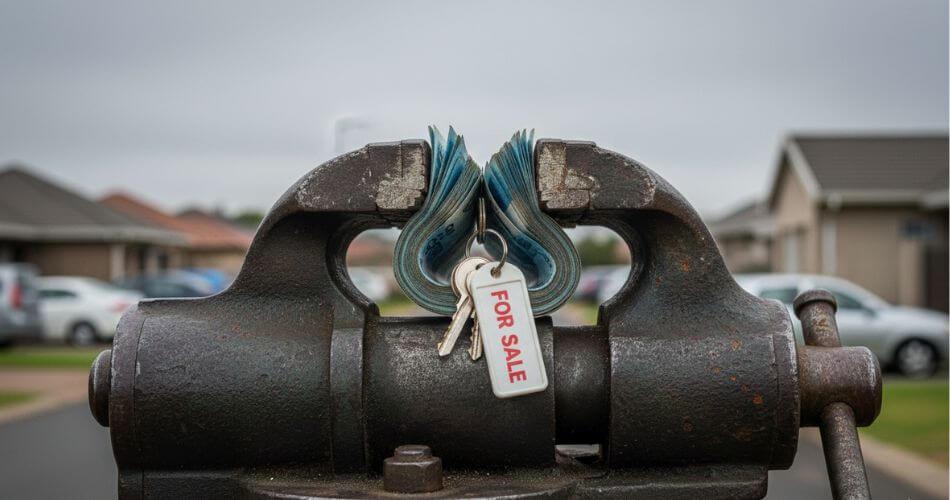
The Repo Rate Reality: Understanding the 10.25% Prime Plateau
The current economic climate is not a personal attack on your career; it is a structural reality. As we enter the first quarter of 2026, the South African Reserve Bank has maintained the repo rate at 6.75%, which anchors the prime lending rate at 10.25%.
While we have seen minor holds throughout 2025, the era of “cheap money” is gone. For a property practitioner in the Northern Suburbs, this means that affordability is the primary gatekeeper.
A middle-income family in Brackenfell looking for a home in the R1.5m to R2.5m bracket is facing debt-servicing costs that are significantly higher than they were three years ago.
You must understand that this 10.25% plateau is the new normal. It is the “Macroeconomic Vise” that squeezes the margins of every transaction.
When you feel the friction of a deal falling through because of a bond rejection, remember that you are operating within a system designed for stability, not speed. The market is not “dead,” it is simply more selective.
By acknowledging that the struggle is structural, you can detach your self-worth from the daily fluctuations of the Deeds Office.
The 87% Filter: Why the 'Painful Stretch' Is a Structural Necessity
In the world of high-performance sales, we call this period the “Painful Stretch.” It is that window of time where your effort is at its maximum, but your visible results seem to be stagnant.
In the Northern Suburbs property market, this stretch serves as a filter. Statistics show that roughly 87% of agents fail within their first two years. This is not because they lack talent, but because they cannot endure the psychological weight of the filter.
The filter exists to remove the uncommitted. When you find yourself surviving the real estate painful stretch, you are actually earning your seat at the table for the next decade.
Every day that you show up while others are quitting is a day you are gaining market share by default. The thinning of the herd in early 2026 is what allows the remaining practitioners to eventually experience abundance. You must view the current difficulty as a barrier to entry that protects your future earnings.
Identifying 'Commission Breath' and the Psychology of Desperation
One of the most dangerous side effects of the Painful Stretch is a condition I call “Commission Breath.” This happens when your need for a paycheck becomes visible to your client. It manifests as high-pressure tactics, frantic follow-ups, and a general air of desperation.
In a market like Brackenfell, where residents value community and stability, “Commission Breath” is a repellent. High-net-worth clients can sense when you are more interested in your R100,000 commission than their long-term financial health.
Overcoming commission breath in sales requires a shift from a scarcity mindset to one of mathematical detachment. You must reach a point where you want the deal, but you do not “need” it for your psychological survival.
When you remove the frantic energy from your consultations, you become a “Gray Rock”—calm, stable, and immovable. This stability is what sellers in the Northern Suburbs are looking for when the economy feels uncertain. They want a mentor, not a predator.d
The Parable of the Die (Dice): Success as a Statistical Inevitability

The 0.28% Conversion Funnel: Why 99 'No's' Are Required for a 'Yes'
To survive as a professional, you must stop viewing rejection as a failure of your character and start viewing it as a requirement of the math. Consider the “Parable of the Die.”
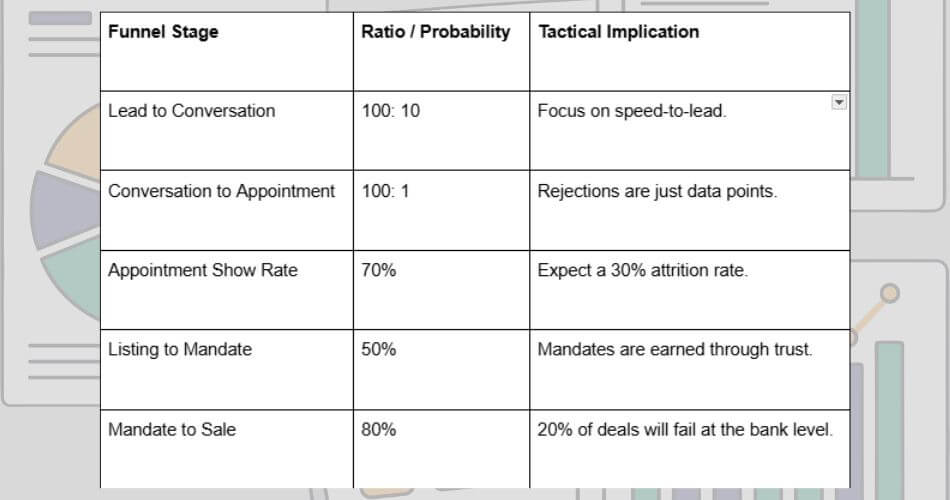
If you are rolling a 100-sided die (dice) where only one side represents a signed mandate, getting a “No” is not a mistake; it is a necessary roll. According to real estate conversion rate statistics 2026, the probability of a single conversation turning into a closed deal in our current market is approximately 0.28%
The Math of the Funnel:
To get to that 0.28% success rate, you must move through a high volume of trials. If you initiate 100 conversations, you might get 10 real leads. From those 10 leads, you might get 1 appointment. If you do this 100 times, the math guarantees a result.
The Valuation Gap: Reframing Bond Rejections as Market Stabilizers
A major hurdle in the 2026 market is the “Valuation Gap.” This is the distance between what a buyer in Brackenfell is willing to pay and what a bank is willing to lend.
Currently, listing prices are often 7% higher than final sale prices. When a bond is rejected because of a conservative bank valuation, it feels like a loss. However, as a performance psychologist, you must reframe this.
The Valuation Gap is a market stabilizer. It prevents the formation of a property bubble that would eventually lead to a crash. When a deal collapses due to a valuation issue, it is the system telling you that the “Die” needs another roll.
The bank’s caution makes certain that the market remains sustainable for the long term. Do not mourn the “lost” commission; acknowledge that the market is protecting itself and move on to the next qualified buyer.
The Persistency Factor: The Math Behind the 7-Touch Rule
Most agents abandon a lead after the second attempt. They assume that if a person does not respond, they are not interested.
This is a psychological error known as the “Spotlight Effect”—you think the client is thinking about you as much as you are thinking about them. In reality, the “Die” of lead conversion is weighted toward those who stay in the game.
Statistical evidence from the 2025 and 2026 periods shows that it takes between 5 and 7 “touches” before a lead converts into a meaningful conversation. This is the “Persistency Factor.”
If you stop at two touches, you are leaving the “Yes” for the agent who has the discipline to reach the seventh touch. Persistence is not about being a nuisance; it is about being present when the client’s “Die” finally lands on the side of “Ready to Sell.”
Finite vs. Infinite Play: The Vredekloof Case Study

The Transactional Predator: Why 'Buying Mandates' Leads to Burnout
In the suburb of Vredekloof, we see a clear distinction between two types of players. The first is the “Transactional Predator”—the finite player. This agent is motivated by the immediate win.
They often try to “buy the mandate” by promising a seller an unrealistically high listing price just to get the signature. They are playing a game with a fixed end point: the commission check.
The problem with this approach is that it leads to a cycle of burnout and resentment. When the property sits on the market for 90 days without an offer because it was overpriced, the agent must then pressure the seller for a price reduction.
This destroys trust and creates a toxic environment. The Transactional Predator is always hunting, always stressed, and always suffering from the scarcity of the next deal.
The Mirror Effect and Gray Rock Method: Building Trust in the Northern Suburbs
The “Infinite Player,” by contrast, understands that the goal of the game is to keep playing. In the Northern Suburbs, this means becoming a trusted advisor rather than a salesperson.
They use the “Mirror Effect” to reflect the needs of their clients and the “Gray Rock Method” to remain a calm, neutral presence during high-stress negotiations.
By being the most stable person in the room, you become the person people want to do business with. The Infinite Player does not care about “winning” a single argument; they care about being the agent that the family calls for every move they make over the next thirty years.
This approach removes the emotional volatility from your career. A “No” today is simply a “Not Yet” in the context of a thirty-year relationship.
The Dual-Node Strategy: Mapping the Brackenfell-to-Durbanville Migration
One of the most significant Northern Suburbs of Cape Town property trends 2026 is the migration pattern between Brackenfell and Durbanville.
Families typically start in entry-level townhouses in areas like Vredekloof or Sonstraal Heights. As their income grows and their children reach school age, they look to move toward the prestigious schools and larger plots of Durbanville.
The Infinite Player uses a “Dual-Node Strategy.” They do not just focus on one suburb; they map the entire lifecycle of the buyer. By handling the sale of the starter home in Brackenfell and facilitating the upgrade in Durbanville, you double your value to the client.
This strategy requires a deep understanding of the local geography and the psychological needs of a growing family. It turns a single transaction into a multi-generational business.
The Green Streak: Leveraging Data, AI, and Integrity for Dominance

The 5-Year Threshold: When the Referral Flywheel Finally Spins
In 2026, the modern agent must be a “Technological Centaur”, half human, half AI. We now have “Agentic AI” that can handle the repetitive, high-volume tasks that used to lead to agent burnout. AI-powered valuations (AVMs) are now accurate within a R11,000 margin of error.
They can analyze market data faster than any human, providing a neutral third-party perspective to ground a seller’s expectations.
By using technology to handle the 0.28% conversion math, you free up your “cognitive load” to focus on the human elements that AI cannot replicate.
AI cannot feel the “soul” of a home in Haasendal or navigate the complex emotions of a divorce sale. Use the tech to find the leads, but use your humanity to close the deals. This combination creates an unmatched operational efficiency that protects you from the exhaustion of the grind.
The Integrity Moat: Why Zero-Tolerance Compliance is Your Greatest Asset
The regulatory environment has shifted significantly. The Property Practitioners Regulatory Authority (PPRA) has adopted a zero-tolerance approach to “kickbacks” and unethical referral fees.
For the finite player, this is a threat. For the infinite player, this is a “moat” that protects their business. When you build your practice on radical integrity, you distinguish yourself from the “Commission Breath” practitioners who are currently being fined or losing their FFCs.
Your reputation for compliance with the PPA and FICA is not a burden; it is your greatest marketing tool. In a market where trust is the most valuable currency, being the agent who does things “by the book” makes you the safest choice for high-end sellers.
Merit-based referrals are the only sustainable foundation for a long-term career. By the time you reach the Green Streak, your integrity will be the reason you are still standing while others have been forced out.
The Brackenfell Market of 2026 is a Test of Character and Physics
The current state of the Northern Suburbs is not merely an economic cycle; it is a psychological crucible designed to separate the professional from the amateur.
When you look at the streets of Brackenfell today, you are looking at a testing ground. The test is not about who can shout the loudest or who has the flashiest social media presence.
The test is about who has the internal fortitude to look at a 10.25% prime rate and see a challenge to be solved rather than a reason to retreat.
It is a test of your ability to remain a “Gray Rock” when a deal is under pressure, and a test of your commitment to the long-term health of your clients over your own immediate financial needs.
This market tests your relationship with the math. It asks if you are willing to do the boring, repetitive work of rolling the 100-sided die day after day, even when the last twenty rolls have yielded nothing but a “No.”
The agents who pass this test are those who understand that “The Painful Stretch” is where the most valuable skills are forged. You are building the “Integrity Moat” that will protect you for the rest of your career.
In the years to come, you will look back at January 2026 as the moment you stopped being a “Transactional Predator” and started being an “Infinite Player.” You are being tested to see if you are worthy of the “Green Streak” that lies ahead.
Synthesis: The Survivor's Mindset for late 2026

The Brackenfell real estate market of 2026 is a crucible. The combination of restrictive interest rates, conservative bank valuations, and a high-volume conversion funnel creates a “Painful Stretch” that only the most resilient will navigate.
By applying the mental models of performance psychology, the practitioner can reframe their daily struggle as a series of necessary statistical trials. You must move forward with the cold, mathematical certainty that success is a matter of physics, not luck.
The “Dice” of the Northern Suburbs property market will continue to land on both sides. The survivor is the one who understands that the game never ends, the die never stops rolling, and the “Green Streak” is always within reach for those who refuse to leave the table.
When you master the performance psychology for real estate agents, you realize that you do not need the market to change for you to succeed; you simply need to remain consistent until the math inevitably tips in your favor.
About the Author
Andre Swart is a respected leader in Brackenfell real estate with over 20 years of results-driven experience. Through his platform, “Andre Swart Inspires,” he moves beyond simple property sales to share the proven mindset, strategies, and habits that build lasting success.
Grounded in integrity, Andre’s mission is to mentor the next generation of top agents and provide homeowners with the trusted guidance they deserve.