
6 Tech Trends Reshaping Real Estate Marketing Trends 2026 in South Africa
Stop farming blindly. See how Lightstone data, Google Gemini, and WhatsApp automation are turning the ‘old school’ hustle into predictable profit.
.

The traditional estate agent is dead. If your entire strategy relies on waiting for a phone call or dropping a thousand flyers into local mailboxes, you are operating a ghost ship. Welcome to the sharp end of the market.
We are examining the real estate marketing trends 2026 in South Africa has forced upon us. The digital hesitancy from the early part of this decade is completely gone, swept away by pure necessity.
Working 18-hour days for shrinking commissions is a broken model. You need a structural shift. Technology is not the enemy; it is the exoskeleton. It is the armor you wear to protect your margins and multiply your reach.
This guide is your blueprint for survival. It is time to mutate, adapt, and become the bionic practitioner your clients actually need.
The 2026 Landscape: Why Hard Work Is No Longer Enough

The Economic Crucible: Surviving 10.25% Prime Rates and Tight Margins
The domestic market operates under specific pressures that simply do not exist in the United States or Europe. Our economy demands absolute transaction efficiency because affordability remains the absolute primary constraint for the residential sector.
The South African Reserve Bank stabilized the prime lending rate at 10.25% after aggressive hiking cycles. We have found a new equilibrium, but the days of easy credit are permanently gone. In this environment, every single basis point matters.
Because of these tight margins, we are seeing the aggressive digitization of bridging finance. Consider platforms like TransBridj. They have transitioned from niche novelties into absolute mainstream necessities.
In South Africa, property transfers are notorious for taking three to four months. Now, AI risk assessment automates compliance and liquidity provision. This means property transfers can proceed with liquidity available in under 24 hours.
Algorithms approve this finance based on the probability of a successful transfer, rather than relying strictly on the applicant’s credit score.
Semigration and Micro-Markets: From the Western Cape Boom to Township Economies
The mass movement of wealth and families from inland provinces like Gauteng to the coastal belts is known as semigration. This shift has matured from a panic-driven exodus into a sustained structural reality.
The Western Cape, and particularly the City of Cape Town and its Northern Suburbs like Durbanville and Brackenfell, continues to decouple from national trends. House price inflation in these areas hovers significantly above the national average.
This creates two completely different markets for artificial intelligence. In the high-demand Western Cape, agents use AI to manage massive volume and filter out unqualified buyers.
In slower inland markets, AI helps agents find buyers and predict available stock. Furthermore, terms like “functioning municipality” have become key search terms in 2026. Automated valuation models must now factor in “municipal health” and “load shedding status”.
Simultaneously, we must acknowledge the formalization of the township property sector. Lightstone data highlights Soweto, Umlazi, and Khayelitsha as vibrant economic hubs.
High-speed internet and smartphone usage are projected to reach over 90% in these areas, bringing these markets fully online.
PropTech models are currently being retrained to understand these specific value dynamics, where proximity to transport nodes drives value over traditional amenities. This data inclusion stands as a massive achievement for the local AI sector.
The Data Moat: Why Reactive Agents Are Losing to Predictive Algorithms
For agency principals, the modern reality is stark. Access to data is your new competitive moat. The volume of transactions is no longer distributed evenly among practitioners.
Instead, volume is increasingly concentrated in the hands of those who actively leverage algorithmic advantages. If your agency does not subscribe to predictive feeds, you are flying completely blind.
Reactive agents wait for the market to happen to them. Bionic agents are predicting the market before it shifts. The subscription cost for these predictive tools is completely negligible when you compare it to the massive cost of lost mandates.
You cannot rely on “gut feel” anymore when your competitors hand sellers a data-backed valuation.
Sellers in 2026 are highly educated and very data-savvy. When a traditional agent goes up against a tech-enabled practitioner, the traditionalist is increasingly being squeezed out. The gap between these two groups is widening at an alarming rate.
It comes down to speed and value. An AI-enabled agent replies to a lead in ten seconds, while a traditional agent takes two hours.
Trend 1: Predictive Intelligence – Stop Farming, Start Snipering

Lightstone's 'Propensity to Sell': Finding Sellers Before They List
The era of reactive estate agency is entirely dead. For decades, the industry operated by waiting for a seller to call or by farming an area blindly.
That inefficiency is no longer viable because customer acquisition costs have risen, and the commission pool is under heavy pressure.
This brings us to learning how to use Lightstone propensity to sell modelling, which localizes predictive analytics for our unique environment.
Lightstone Property is the undisputed leader in this specific space. By 2026, their engine will serve as the absolute backbone of high-performance agencies and will integrate directly into CRMs like Prop Data and PropCon.
Because strict consumer credit protections prevent the use of US-style models, Lightstone utilizes a localized matrix of proxy indicators.
These indicators include Tenure Analytics, which analyzes the average holding period in a suburb like Durbanville. As a property nears the average 12-year hold mark, its propensity score increases.
The system also tracks Bond Cancellation Patterns at the Deeds Office, recognizing that a bond switch often precedes a sale or renovation.
It even infers “life stage changes” from anonymized vehicle registrations, noting when a household upgrades to a larger SUV.
The Death of the Flyer: Targeted Marketing in Table View
Let us examine the massive operational impact this has on the agent. In 2020, the old method involved printing 5,000 flyers and paying a distribution company to drop them into every single mailbox in Table View.
That approach carried a high cost, a conversion rate of less than 0.1%, and generated significant environmental waste.
The 2026 workflow looks completely different. The modern agent logs into the Prop Data Manage system, opens the “Canvassing” module, and applies a specific filter.
They ask the system to show homeowners in Table View who have owned their property for over five years and possess a propensity score above 75%.
The system returns a highly targeted list, perhaps 143 specific addresses. The agent then focuses their entire marketing budget on just those 143 homes.
They send personalized hand-written notes, make targeted calls where compliant with privacy laws, and engage via custom social media audiences.
This “Sniper” approach increases conversion efficiency by massive orders of magnitude.
From AVM to EVM: The Human-in-the-Loop Valuation Advantage
South African agents have historically viewed the Automated Valuation Model with deep suspicion. They argued it was inaccurate because a computer could not see expensive granite tops or a damp spot on a ceiling.
By 2026, this binary thinking has evolved into a highly collaborative model.
Lightstone’s Artificial Intelligence Valuation Model (AiVM) is now accredited by the European AVM Alliance. It utilizes neural networks to analyze non-linear variables.
For instance, it understands that a “view” adds exponential value in Clifton, but “security” serves as the exponential multiplier in Parow. However, the real trend is the Estate Agent Valuation Model (EVM).
The EVM allows the practitioner to act as the “Human in the Loop”. The algorithm provides a baseline value alongside a “Confidence Score”.
If that score is low due to sparse data, the agent manually adjusts the parameters based on a visual inspection.
Advanced integrations like LOOM Property Insights even use computer vision to analyze listing photos, automatically decoding the value difference between a 1990s kitchen and a 2026 renovation.
Trend 2: Generative Engine Optimization (GEO) – Be Found by the Machine

Zero-Click Search: Why Google Gemini is Bypassing Property24
The fundamental way South Africans search for property has shifted permanently. For two decades, a search involved typing keywords into Google and clicking on a link to Property24 or Private Property.
Today, a search means asking an AI a direct question and receiving a synthesized answer without ever clicking a single link. This “Zero-Click Search” phenomenon demands a total overhaul of your digital strategy.
When a Sandton buyer asks Google Gemini about the safest security estates in Midrand with nearby schools and good resale value, they do not want ten blue links.
They want an answer. Gemini synthesizes information from across the web to generate a paragraph-long recommendation.
The AI might specifically recommend Waterfall Estate and Kyalami Estates, citing market data for capital appreciation and proximity to Reddam House.
If your agency’s content is not the original source of this synthesized information, you are completely invisible to the buyer. This shift poses a massive threat to traditional portals, giving agents a chance to bypass them entirely.
Your Google Business Profile: The Digital Anchor in Kuils River
Generative Engine Optimization (GEO) focuses on optimizing content for Large Language Models instead of traditional keyword crawlers.
In our local context, the Google Business Profile for estate agents is the single most critical asset for GEO. When a user in Kuils River searches for estate agents near them, Gemini looks directly at that profile first.
Completeness is absolutely non-negotiable. If your profile is missing its operating hours or phone numbers, the AI discards it as unreliable. You must treat this platform as your primary digital storefront.
Optimization requires active management. Agents are deliberately seeding their Q&A sections with natural language questions, such as asking if they do valuations in Haasendal, and then providing detailed answers.
Gemini scrapes these sections to directly answer user queries. Furthermore, regularly uploading photos of “Just Sold” boards provides visual signals to the AI. AI vision models analyze the backgrounds of these images to confirm the neighborhood context.
Entity Authority: Proving Your Local Expertise to AI Answers
To rank in an AI-generated answer, an estate agent must establish themselves as a trusted “Entity”. Large Language Models categorize the world into entities, which include people, places, and businesses.
Establishing this authority requires a consistent digital footprint across multiple respected sites like IOL Property, Real Estate Investor, and LinkedIn. This footprint confirms your identity and your specific expertise.
Your website must explicitly communicate with the machine. Practitioners must use Schema Markup on their websites. This structured data clearly tells the algorithm: “This is a Review,” “This is a Price,” or “This is a Service Area”.
Without this specific structured data, the algorithm cannot confidently extract the factual points it needs to construct an answer for the user.
The machine needs proof of your expertise. You must package your local knowledge in a format the algorithm can ingest and verify instantly.
Trend 3: The Video Transcript Economy – Ranking Without Writing
How Google Gemini Actually 'Reads' Your Local YouTube Videos
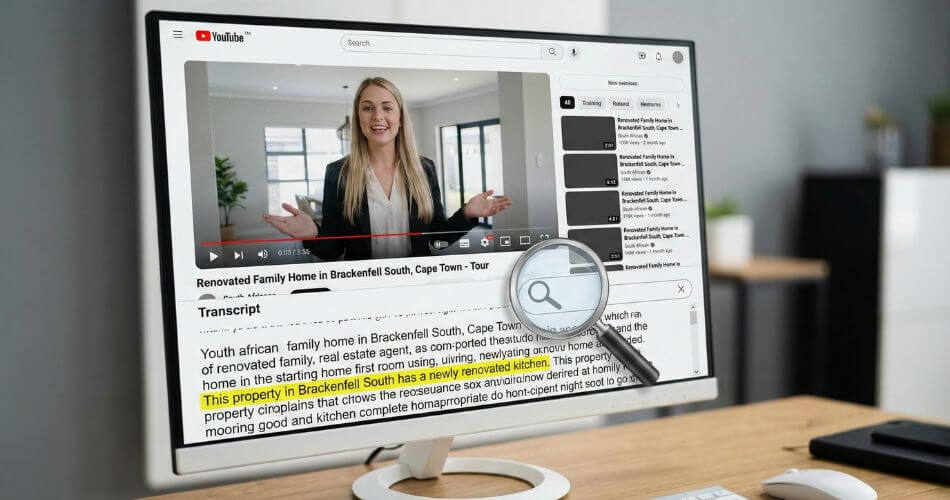
We must address a massive validation query regarding search behavior: does Google’s Gemini index YouTube video transcripts locally, and does it function as a ranking factor? The analysis confirms that transcript indexing is active and serves as a primary lever for local search dominance.
Google’s Gemini model is multimodal. This means it processes text, images, audio, and video all at the same time. It does not merely read your video title; it actually consumes the content within the file.
When a video is indexed, the system converts the audio track and visual frames into units of meaning known as tokens.
While the model can process raw audio, doing so is computationally expensive. Therefore, the algorithm heavily prioritizes the transcript, or closed captions, as its primary data source for understanding the topic.
In South Africa, automated speech recognition frequently struggles with local accents and place names like Kraaifontein or Umhlanga.
If you rely on auto-generated captions, the machine might hear “Crown fountain” instead of “Kraaifontein,” which means it fails to index your video for the correct location. Mastering YouTube transcript seo for property is a massive arbitrage opportunity.
Exploiting 'Data Voids': Owning the Search for 'Living in Sonstraal Heights'
The concept of a “Data Void” is essential for your strategy. In the US, searching for “Living in Austin, Texas” yields millions of blog posts.
But if you search for “Living in Sonstraal Heights, Durbanville,” you will find very little high-quality written content.
Because the written web is sparse for local suburbs, the algorithm is desperate for data sources to answer user questions.
A hyper-local video with a clean, manually corrected transcript immediately becomes the authoritative source of data for that specific query.
When a user asks Gemini if Sonstraal Heights is a safe area, the AI scans its index, finds no blog posts, but finds your video transcript.
If your transcript explicitly states that Sonstraal Heights is known for its safety and active neighbourhood watch, the AI uses that exact sentence to construct its answer and cites your video.
You must adopt a strict video-to-text workflow. Film the hyper-local video, use an AI tool to generate the text, and manually correct all local slang and technical terms like FICA. Upload the clean SRT file to YouTube and never rely on auto-generation.
Short-Form Dominance: CapCut Hooks and TikTok Show Houses
While YouTube dominates high-intent search, platforms like TikTok and Instagram Reels absolutely dominate discovery. The technical barrier to entry for video editing has completely collapsed.
South African agents widely use tools like CapCut. These tools utilize artificial intelligence to automatically remove silences from your speech, add karaoke-style captions that are vital for sound-off viewing, and identify viral hooks within your footage. AI analytics also provide second-by-second retention graphs to guide your editing.
The psychology of the hook is brutal. Agents now know that if they do not say the words “Cape Town” or “R2 million” within the first 1.5 seconds, the viewer simply scrolls away.
This metric has driven a highly stylized and fast-paced content format. This specific energetic format now completely dominates the social feeds of Generation Z and Millennial buyers.
Trends 4 & 5: Conversational Commerce and the Regulatory Cage

WhatsApp Automation: Achieving Instant 'Speed to Lead' with PropCon and Flow
In the United States, SMS text messaging remains king, but in South Africa, WhatsApp operates as the absolute operating system of society.
By 2026, the real estate industry fully acknowledge that email is a dying channel for consumer communication. The industry has fully adopted Chat Commerce.
The friction of email is clear: response times are measured in hours or even days. Conversely, WhatsApp response times are measured in minutes.
In our highly competitive environment, “Speed to Lead” is the single metric that matters most. But a practitioner cannot manually handle 50 incoming conversations while driving to a property viewing.
The solution is intelligent WhatsApp marketing automation PropCon and platforms like Flow provide. PropCon features Broadcast lists that send personalized messages to 500 people simultaneously, appearing as direct 1-to-1 chats and bypassing intrusive group formats.
Flow automates the top of the funnel by routing Facebook ads directly into a WhatsApp conversation. An AI bot immediately engages the user, gathering budget and location data before notifying the human agent.
POPIA Section 71: The Liability of 'Computer Says No' Tenant Rejections
We operate inside a unique regulatory cage constructed by the Protection of Personal Information Act (POPIA).
While US agents focus on Fair Housing laws, our regulators are strictly focused on artificial intelligence, specifically Section 71 regarding automated decision-making.
Navigating popia compliance for real estate agents is not optional; it is survival.
Section 71 creates strict liability structures unknown to US agents. It applies to decisions made solely by automated means that affect a person’s legal rights. Imagine a tenant applying for a rental in Sea Point.
The agency uses an algorithmic tool to score the tenant. If the system sees a high-risk flag and automatically sends a rejection email without human review, the agency violates Section 71.
Denying housing by machine without human oversight can lead the Information Regulator to impose fines of up to R10 million. Your only defense is the “Human in the Loop” protocol.
You must thoroughly document that the algorithm recommended the rejection, but a human actively ratified that decision.
The TPN Shield: Vetting Safely Within the Regulatory Cage
Another major regulatory hurdle is the “Right to Explanation” under Section 71. If a tenant asks why their application was rejected, you cannot simply say the algorithm made the choice.
You must explain the underlying logic, such as noting a debt-to-income ratio exceeding 45%. This legally requires the use of “White Box” tools that are transparent, rather than opaque deep learning models.
Furthermore, the old tactic of using software to scrape LinkedIn for phone numbers to send unsolicited messages is a flagrant violation of Section 69.
The regulator has cracked down heavily, meaning agents must rely entirely on legitimate, opt-in databases.
This is where the Tenant Profile Network (TPN) becomes critical. TPN serves as a powerful compliance shield, acting as the bridge between raw data and the practitioner.
Their systems make sure that all algorithmic scoring complies with the National Credit Act and privacy laws. Using rogue international tools for tenant vetting exposes your business to massive and unnecessary liability.
Trend 6: The Era of the Bionic Practitioner

The 'Centaur' Model: Merging Human Empathy with Machine Speed
The era of the Bionic Agent has officially arrived. The fear that machines will replace estate agents has dissipated.
Instead, the nuanced reality is clear: agents who use technology will replace agents who refuse to adapt. This synthesis is known as the Centaur model, which pairs human empathy with machine efficiency.
In this Centaur structure, the machine handles data processing, pattern recognition, 24/7 responsiveness, compliance checking, and drafting marketing copy.
The human practitioner handles empathy, complex problem solving, ethics, negotiation, and managing the high emotional volatility of a property transfer. This model does not replace you; it augments your capabilities.
The most concrete, immediate benefit is your liberation from administrative drudgery. Tools like PropBot allow you to type a basic prompt about a three-bedroom fixer-upper in Vredekloof, and it generates a compelling listing description in seconds.
Visual tools even virtually stage vacant properties to match target demographics, saving you massive staging costs.
The Northern Suburbs Playbook: High Value in Durbanville vs. High Volume in Brackenfell
To see these concepts in action, look closely at the micro-market of Cape Town’s Northern Suburbs, a region heavily impacted by the semigration boom. The strategies change entirely based on the specific suburb profile.
In the affluent market of Durbanville, where the median price sits around R3.1 million, agents deploy Predictive Intelligence to target “Empty Nesters”.
They look for owners who have lived in large family homes for over 20 years. Using Lightstone’s life stage data, they show these sellers the clear financial benefits of downsizing into new retirement developments like Zonnezicht.
Conversely, in the fast-moving Brackenfell market, where entry levels sit around R1.5 million, the strategy heavily prioritizes automation and short-form video.
Agents push “First Time Buyer Tips” and high-speed townhouse tours onto TikTok and Instagram Reels.
Automated bots then handle the massive volume of incoming chat inquiries, filtering for pre-qualification so the human only deals with buyers who are financially ready.
Your Strategic Roadmap: First 3 Steps to South African Digital Dominance
We are no longer waiting for the future; we are actively building it. To dominate in this market, you must follow a strict roadmap.
First, understand that data hygiene is absolutely non-negotiable. You simply cannot run advanced algorithms on dirty data. Make sure your CRM data is fully categorized and compliant with privacy regulations.
Second, take total ownership of your digital entity. Treat your business profile as your primary storefront and optimize it obsessively.
Third, adopt the video-to-text workflow immediately. Validating your video content is the easiest path to search dominance in our data-sparse local web.
Do not leave Section 71 compliance to chance; implement software that builds human oversight directly into your workflow. Finally, teach yourself and your team the art of prompt engineering.
Knowing how to ask the algorithm the right question is the most critical soft skill of this decade. The market rewards the practitioner who uses algorithms to find the seller, generative search to capture the buyer, and a deep human connection to close the deal.
Augmentation is your path forward. This is how you master the real estate marketing trends 2026 in South Africa demands of you. Look at the data, adapt your methods, and lead your agency into the bionic future
About the Author
Andre Swart is a respected leader in Brackenfell real estate with over 20 years of results-driven experience. Through his platform, “Andre Swart Inspires,” he moves beyond simple property sales to share the proven mindset, strategies, and habits that build lasting success.
Grounded in integrity, Andre’s mission is to mentor the next generation of top agents and provide homeowners with the trusted guidance they deserve.