
Mentoring Intern Estate Agents
Why We Are Failing Gen Z in Real Estate
Standing at an intersection is not mentorship. It is a safety risk, a brand liability, and a compliance failure. Here is the modern alternative.

The image is stark and familiar to any Capetonian. It is a Tuesday afternoon in peak traffic. A young person stands alone at a busy intersection. They clutch a stack of glossy A5 flyers. They step off the curb and into the road.
They try to make eye contact with drivers who are actively ignoring them. This young person is likely a university graduate or a matriculant with high hopes.
They are mentoring intern estate agents in the eyes of their Principal. But in reality, they are being hazed.
This practice is dangerous. It damages the brand of every agency that participates in it. It is a relic of a bygone era that refuses to die. We need to have a difficult conversation about the difference between training and exploitation.
The industry is currently facing a crisis of attrition and a crisis of safety. We are losing talented young people because we refuse to modernize our methods.
It is time to look at the data. It is time to look at the law. It is time to stop sending our future leaders to play in traffic.
The Legacy Hazing: Why the 'Robot Flyer' Kills Your Brand
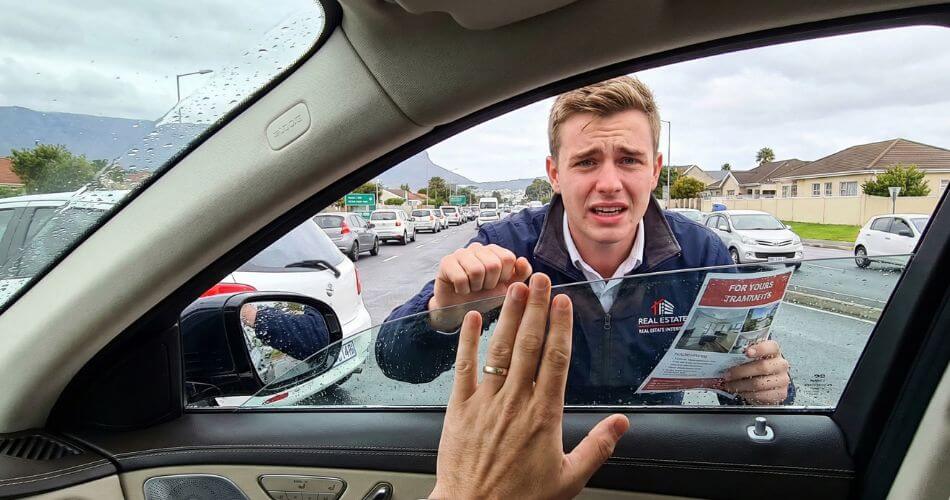
The Safety Crisis: Identifying Smash-and-Grab Hotspots in Cape Town
To understand why the “Robot Flyer Fallacy” is so egregious, we must look at the operational reality of the Northern Suburbs of Cape Town.
There is a dangerous assumption among Principals that because an intersection is not in a “Red Zone” it is therefore a safe classroom.
This is a fatal error in judgment. When a Principal assigns a Generation Z intern to distribute flyers at a busy suburban traffic light, they are making a calculated risk assessment that values a low-probability lead over human safety.
The data regarding operational risk is clear. We are not talking about remote areas. We are talking about the economic arteries of our residential markets.
The common training grounds are typically Durban Road near Tygervalley, the high-volume intersections along Brackenfell Boulevard, and the busy arterials of Kuils River such as Bottelary, Amandel, and Saxdown Roads.
While these areas are not classified as war zones, they are certainly not pedestrian-friendly workspaces. Durban Road is effectively a multi-lane highway during peak hours. Bottelary Road carries high-speed traffic that often disregards the speed limit.
Placing an intern on a narrow median strip in these locations exposes them to significant traffic hazards. A moment of inattention from a driver changing lanes or a taxi skipping a red robot can result in tragedy.
Furthermore, we must address the “Safety Creep” in the Western Cape. Opportunistic crime is not static. It migrates to where the targets are.
The intersections at Saxdown and Amandel are prime targets for opportunistic smash-and-grab incidents precisely because motorists feel safe enough to leave valuables on the passenger seat.
By placing a branded intern in this environment, we are not just exposing them to traffic; we are designating them as a soft target in an environment where situational awareness is the only defense.
Interruption vs. Permission: The Psychology of the Annoyed Driver
Beyond the physical danger, the Robot Flyer Fallacy represents a catastrophic misunderstanding of modern marketing psychology.
The industry is currently engaged in a friction between two opposing philosophies. There is “Interruption Marketing” which is the legacy model, and “Permission Marketing” which is the modern standard.
The flyer is the quintessential tool of interruption. Its mechanism forces a message upon a consumer who is engaged in another high-cognitive-load task.
In the context of a busy morning on Brackenfell Boulevard, the consumer state is one of high stress. The driver is navigating the school run. They are watching for taxis cutting in. They are checking their mirrors.
When an intern taps on the window or thrusts a flyer into their peripheral vision, the psychological reaction is not interest. It is an annoyance. It is an intrusion. It is a defensive spike in adrenaline.
The brand association created here is negative. The agency becomes linked with the threat to the driver’s personal space. This destroys your efforts in Building a Trusted Real Estate Brand. The flyer itself is often discarded immediately.
It becomes litter on the verge of Bottelary Road. It becomes visual pollution that degrades the standing of the brand in the community.
Contrast this with the Permission Marketing model. This model delivers value to a consumer who has signaled interest. When a potential buyer clicks on a link for a Kuils River market report, they are in a receptive state.
The interaction is voluntary. The psychological reaction is gratitude for relevance. This builds trust, which is the currency of real estate. Generation Z intuitively understands this dynamic, yet we force them to violate it daily.
The Survivorship Bias: Why 'Old School' Grit Doesn't Work in 2026
Why does this fallacy persist? If the ROI is low and the risk is high, why do Principals insist on it? The answer lies in the Survivorship Bias of the current leadership.
Many Principals built their books in the 1990s and early 2000s. This was a pre-digital era where hitting the pavement was the only viable way to build visibility.
They suffered through the rejection and the heat. They succeeded. Therefore, they reason that the current generation must also suffer to prove their commitment.
This logic is flawed because the environment has fundamentally changed. The street corner of 1995 is not the street corner of 2026.
The violent crime rate has escalated. This changes the pedestrian-motorist dynamic from neighbourly to defensive. The Attention Economy has also shifted. In 1995, the driver was looking at the road and the scenery.
In 2026, the passenger is looking at their phone. Attention has migrated to the screen. Standing at the window is trying to capture attention in a place where it no longer resides.
By forcing Gen Z interns to reenact the struggles of the past in a present that no longer rewards them, Principals are engaging in ritualistic hazing. They are filtering for desperation rather than talent.
Smart candidates look at the flyer requirement and rightly conclude that the agency is stuck in the past. This is why new estate agents fail to stay in the industry.
They leave not because they are weak but because they are smart enough to recognize a bad strategy.
The Legal Pivot: Operational Risk and the "Illegal Instruction"

We have discussed the physical danger and the brand damage. Now we must discuss the insolvency risk. Most Principals operate under the mistaken belief that if an intern is hit by a taxi or stabbed by a robot, “Workmen’s Comp” (COIDA) will handle it.
This is a dangerous delusion.
The recent Operational Risk and Legal Liability Analysis reveals a “perfect storm” of liability. By instructing a Candidate Property Practitioner to distribute flyers at a traffic intersection, you are not merely engaging in old-school marketing.
You are issuing an unlawful instruction that may pierce your corporate veil and expose you to uncapped personal liability.
1. The Municipal Trap: Bylaw 10518
The foundation of your liability lies in the illegality of the act itself. The City of Cape Town’s Outdoor Advertising and Signage Bylaw No. 10518 is explicit.
Section 47(5) states unequivocally: “No one may distribute pamphlets to motorists in the moving traffic within public roads.”
Principals often argue that a car stopped at a red light is stationary. Legally, this is incorrect. A vehicle in a traffic lane with its engine running, waiting for a signal, is part of the “flow of traffic.” Furthermore, the bylaw defines the “public road” to include the verge and the median.
The Consequence: When you instruct an intern to step off the curb to hand a flyer to a driver, you are instructing them to violate a municipal bylaw.
In South African labor law, an employer’s right to command is limited to instructions that are “lawful and reasonable.” This instruction is neither.
If a Candidate refuses to go to the robot and you discipline them, you are walking into a CCMA buzzsaw. The dismissal would be substantively unfair, and the compensation for firing an employee for refusing to perform an illegal act can be up to 24 months’ remuneration.
2. The COIDA Immunity Fail: Piercing the Shield
The Compensation for Occupational Injuries and Diseases Act (COIDA) is supposed to be your shield. It creates a “grand bargain” where employees give up the right to sue you in exchange for guaranteed statutory compensation.
However, this shield has a crack.
The “Illegal Act” Exclusion: The Compensation Commissioner has the discretion to repudiate claims if the employee was engaged in a serious illegal act.
Because the distribution of flyers to moving traffic is a violation of the Bylaw, the Commissioner can argue that the activity falls outside the lawful “course and scope” of employment.
The “Inherent Risk” Precedent: In cases like Hobongwana v Benteler, the courts have distinguished between risks “inherent” to the job and “perils of the street.” Is being held up at gunpoint inherent to the job of a Real Estate Agent? You might say no.
If COIDA repudiates the claim because the act was illegal or the risk was not inherent, your Section 35 immunity falls away. The intern (or their family) can now sue you directly for Civil Damages.
Unlike COIDA, which is capped, civil claims for “General Damages,” “Pain and Suffering,” and “Future Loss of Earnings” are uncapped.
If a 22-year-old intern is permanently disabled because you sent them to a robot, you could be facing a claim of millions of Rands.
3. Gross Negligence and the OHSA Violation
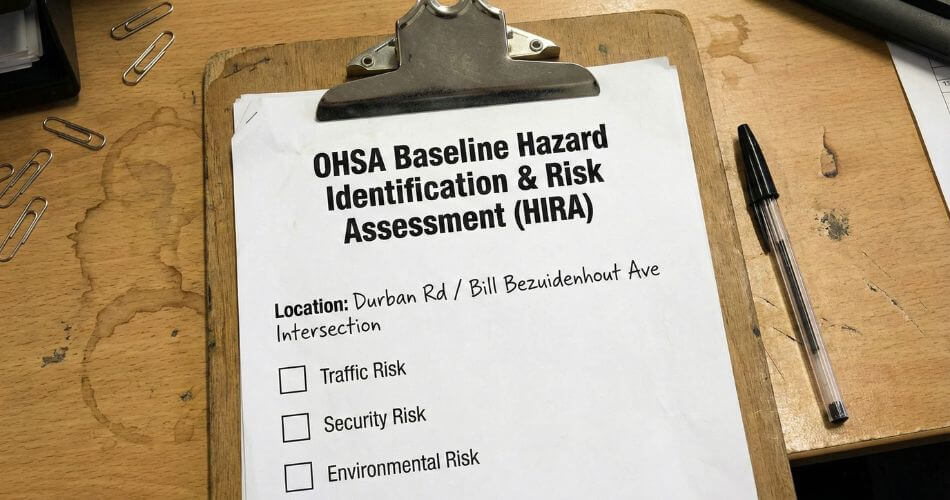
The Occupational Health and Safety Act (OHSA) imposes a non-delegable duty on you to provide a safe working environment. This extends to wherever you send your staff.
The “Creation of Risk” Doctrine: Under the Supreme Court of Appeal’s ruling in Stallion Security, an employer is liable if they “created the risk” of harm.
By instructing the intern to stand at a specific intersection to promote your brand, you are the causa sine qua non (factual cause) of the injury. But for your instruction, they would not have been there.
The Missing HIRA: Have you conducted a formal Hazard Identification and Risk Assessment (HIRA) for the corner of Durban Road and Tyger Valley? Have you formally identified the “smash-and-grab” risks? If not, you are in breach of OHSA.
If you send an intern to a known hotspot—an area flagged by the City or SAPS as a “high risk” zone—without a security escort, you are arguably committing Gross Negligence.
Insurance policies almost universally exclude “Illegal Acts” and “Gross Negligence.” This means when the lawsuit comes, your Public Liability Insurance will likely repudiate it, leaving you to pay the millions from your own pocket.
4. The Supervision Lie
Finally, let us look at the Property Practitioners Act. Regulation 2 mandates that a Candidate must operate under “active supervision.”
The PPA defines “marketing immovable property” as a regulated function. When a Candidate stands at a robot wearing your brand, they are “holding out” your services.
If they are there alone, without a mentor present, you are in breach of the supervision requirement.
You cannot claim to be “mentoring” someone when you have abandoned them on a traffic island to break the law.
This is not training; it is a compliance violation that falsifies the records for Module 4 (Brand Development) of the new practical training course. You are teaching them to break the law, not build a brand.
The Compliance Trap: Admin Dumping vs. PPA Training

The Legal Risk: Are You Signing False Competency Letters?
The transition from the Estate Agency Affairs Act to the Property Practitioners Act (PPA) of 2019 marked a massive shift in the regulatory environment.
Effective July 1 2024, the old Logbook system was officially phased out. It was replaced by a structured Practical Training Course comprising six modules.
This regulatory evolution was intended to professionalize the industry. However, a forensic audit of current mentorship practices reveals that the industry has largely swapped one form of bureaucratic failure for another.
The Logbook has been replaced by “Admin Dumping.” This practice may violate the legal obligations of the Principal under the new regulations.
The critical regulatory change is in the sign-off. The requirement for a physical logbook was removed. Instead, Principals and Mentors must submit a standard letter confirming that the candidate has competently completed the internship.
This seemingly simple change carries profound legal weight. The signature of the Principal on that letter is a formal declaration to the PPRA.
It states that specific training standards have been met. It shifts the burden of proof from the folder of the intern to the integrity of the Principal.
Regulation 33.2.3 specifically mandates that the practical training must equip the practitioner with the necessary practical skills.
If an audit reveals that training consisted solely of coffee runs and flyer drops, the Principal faces disciplinary action. They are in breach of the Code of Conduct.
Data Entry is Not Mentorship: The Lightstone Misunderstanding
“Admin Dumping” occurs when a Principal assigns an intern low-level administrative or menial tasks under the guise of learning the ropes.
Let us audit this against the Property Practitioners Act training modules. Specifically, we must look at Module 3 and Module 4.
Consider Scenario A regarding the database. An intern spends three months manually typing old business cards into an Excel spreadsheet. The Principal claims they are completing Module 3: Procedures to build internal/external client relationships and databases.
This is a fallacy. Data entry is a clerical task. It is not a relationship-building procedure.
The competency required by Module 3 involves understanding data segmentation. It involves the strategy of communication. It requires knowledge of POPIA compliance and the conversion of data into leads.
If the intern types 500 names but cannot explain the difference between a cold lead and a nurture sequence, they have not been trained. If the Principal signs the confirmation letter, they are making a false declaration.
Consider Scenario B regarding brand reputation. An intern is sent to put up “Sold” boards in hard soil. The Principal claims they are completing Module 4: Procedures to build a brand reputation. This is incorrect.
Physical labor is not a brand strategy. Market development requires intellectual work.
It requires analysis of demographics using tools like Lightstone. It requires understanding buyer personas. The intern has performed manual labor. They have not learned brand strategy.
The Financial Reality: Why 80% of Interns Quit in Year One
It is a widely cited statistic that approximately 80% of new agents fail within their first year. The Admin Dumping culture is a primary driver of this attrition.
Candidate practitioners are typically employed on a commission-only basis. The PPA prohibits them from operating independently. They are reliant on the Principal to help them close deals to earn income.
If the training consists of non-revenue-generating activities, the intern starves. They cannot sustain 6 to 12 months of zero income while being treated as an unpaid personal assistant. The promise of future commission rings hollow when the daily tasks have no correlation to closing a sale.
Gen Z is often mischaracterized as entitled. In reality, they are highly attuned to value. They are willing to work hard if they see the trajectory.
When they realize that standing at a robot or filing papers has zero correlation to the success of the top agents, they disengage. They interpret Admin Dumping correctly as exploitation.
Furthermore, the regulatory barrier to entry is high. Candidates must navigate the NQF4 qualification and the PDE4 exam. This requires significant study. If the mentorship does not actively assist them in passing these hurdles, the intern feels set up to fail.
They are drowning in regulation without a lifeline. This lack of support, combined with financial starvation, creates the perfect storm for attrition.
The 2026 Marketing Stack: Tools That Actually Work

Digital Farming: Mining Databases Instead of Walking Streets
To address the crisis of mentorship, we must pivot to modern real estate lead generation. We must stop handing interns flyers and start handing them logins. The “2026 Marketing Stack” is data-driven and safety-conscious.
Legacy agents use farming in its physical sense. They drive streets and knock on doors. While there is value in knowing an area, the physical act is inefficient compared to Data Mining.
The modern tool for this is Lightstone Property or TPN. A modern mentor teaches the intern how to use these tools for sniper targeting rather than shotgun flyers.
The modern workflow is specific. The mentor instructs the intern to log into Lightstone. They pull a Suburb Trends Report for a specific area like Sonkring.
They filter for homeowners who purchased properties 7 to 10 years ago. These owners have likely built up equity and may be ready to upgrade. They filter for properties that have not been bonded recently.
Instead of a generic flyer, the intern drafts a personalized Property Valuation Update for these 50 specific homeowners. The hook is data. “Dear Mr. X, homes in Sonkring have appreciated by 12% in the last 3 years.”
This approach satisfies Module 3 and Module 4. The intern learns market analysis and copywriting. The homeowner receives valuable data.
The Vertical Video Revolution: Turning Interns into Content Creators
The research identifies video as the highest-engagement medium in the current landscape. Listings with video get 403% more inquiries.
Vertical video dominates mobile consumption on platforms like TikTok and Instagram Reels. This is one of the most effective real estate marketing ideas in South Africa has available.
Instead of sending an intern to a robot, we must send them to a new listing with a smartphone. This utilizes their inherent digital skills. The instruction is to create three 15-second vertical videos.
The first video is the Hook. It focuses on the most unique feature like an indoor braai. The second is the Lifestyle video showing the flow from the kitchen to the patio.
The third is the Neighborhood video showing the local park. The intern learns framing and editing. They learn to identify the Unique Selling Proposition.
A single Reel can reach 5,000 locals in the specific geo-fenced area for zero cost. A flyer reaches one person and costs money. This strategy is safe. It is effective.
It builds the digital brand of the agency. It turns the intern into a Content Creator, which is a role they value.
Community Management: Building Authority in Local Facebook Groups
Physical farming carries safety risks. Digital farming builds authority where the people actually are. Facebook Community Groups are the modern town squares. Groups like “Brackenfell se Mense” or “Kuils River Community” are vital hubs.
Legacy agents often spam these groups with sales posts. This violates group rules and gets them banned. Modern mentorship teaches the intern Community Management and Social Listening. The strategy is to post value.
The tactics are subtle. The intern posts a service query asking for a reliable plumber because a seller needs one. This positions the agent as busy and working. They share information such as the latest crime stats report. They provide market updates about how fast homes are selling.
This effectively teaches the intern how to build client relationships in a compliant way. It is safety for real estate agents in Cape Town mandates. It keeps them off the street and places them in the center of the digital conversation.
The Audit: A Checklist for the Modern Principal

The 'Stupid Mentor' Diagnostic: Are You Guilty of These Habits?
To conclude this analysis, we must use a diagnostic tool. This “Stupid Mentor Checklist” applies the Inversion Mental Model for Business to your management style.
It forces a confrontation between the self-image of the Principal and the reality of their management style.
- The “Coffee Run” Compliance Check Question: Does your intern spend more time making coffee or running personal errands than they do logged into the CRM? Diagnosis: If yes, you are Admin Dumping.
You are not training an agent. You are underpaying a secretary. This violates the spirit of the PPA Practical Training Course. The Fix: Hire an admin assistant for admin. Train the intern to negotiate and analyze the market.
- The “Osmosis” Delusion Question: Do you have a scheduled, written curriculum for your intern, or do you just tell them to “shadow” you?
Diagnosis: Shadowing is passive. Unless you are narrating your thought process and letting them drive the interaction, they are learning nothing. They will fail the PDE4 because they have not learned the theory.
The Fix: Implement the 6 Modules structured plan. Weekly sit-downs to review their output, not just yours.
- The “Virtual Agent” Treadmill Question: Do you use your intern as a manual bridge between Lightstone and Virtual Agent?
Diagnosis: The agent asks for a street report to get the owner ID numbers. They then force the intern to input these into Virtual Agent one by one to get contact numbers. It is an extremely time-consuming and boring process.
The Reality: The tragedy is the waste. The intern delivers the list but you never make the calls. 95% of agents fear the rejection of the cold call so the list sits on the desk.
This fear is a failure of Performance Psychology for Real Estate Agents.When the intern holds you accountable and asks why you have not dialed the numbers they spent hours finding you get defensive.
The Fix: Stop pretending you will call. Use a bulk import tool or teach the intern to send value-add emails to a permission-based list instead.
- The “Digital Denial” Question: Do you forbid interns from using TikTok or social media during work hours?
Diagnosis: You are handcuffing their greatest asset. They speak the language of 2026. You speak the language of 1996.
The Risk: Your agency becomes invisible to the next generation of buyers and sellers. The Fix: Task them with managing the agency’s social media. Let them teach you about vertical video.
Safety Protocols: The Non-Negotiable Standard for Staff
We must also apply the “Durban Road” Test. Have you sent an intern to distribute flyers at a high-volume intersection like Bottelary or Amandel in the last 6 months?
If you have, you are prioritizing a low conversion rate over the physical safety of your staff. You are suffering from Legacy Hazing syndrome.
The risk is liability. It takes only one distracted driver skipping a red robot or one opportunistic smash-and-grab incident to turn a marketing activity into a medical emergency.
The risk is also degrading your brand by associating it with street hawking. The fix is to reallocate the printing budget to a boosted Instagram post.
Keep the intern in the office or at a show house. Safety must be the non-negotiable standard.
Conclusion: From Hazing to High Performance

The Crisis of Mentorship in the Western Cape real estate market is not a crisis of the youth. It is a crisis of the elders. Generation Z is not lazy. They are efficiency-seeking and risk-averse in a dangerous world.
They are rightfully rejecting the Legacy Hazing of the Robot Flyer because they can see that it does not work.
We are failing Gen Z because we refuse to update our operating system. We cling to how it was done while ignoring the audit that demands we do better.
The Property Practitioners Act has handed us a framework for professionalization. The 2026 Marketing Stack has handed us the tools for efficiency.
It is time for the Real Estate industry to put down the flyers. We must lock the office door against Admin Dumping. We must start actually mentoring intern estate agents. If we do not, the attrition stats will continue to rise.
The legacy agencies will find themselves outpaced by digital-first disruptors who understand that the brain of an intern is more valuable than their ability to stand at a robot.
About the Author
Andre Swart is a respected leader in Brackenfell real estate with over 20 years of results-driven experience. Through his platform, “Andre Swart Inspires,” he moves beyond simple property sales to share the proven mindset, strategies, and habits that build lasting success.
Grounded in integrity, Andre’s mission is to mentor the next generation of top agents and provide homeowners with the trusted guidance they deserve.