
How To Stand Out As A Real Estate Agent
The Crisis of Sameness: How Northern Suburbs Agents Can Defeat Digital Invisibility
Ditch the generic AI prompts and ‘Just Sold’ boards. Discover the definitive blueprint for building high-intent, hyper-local trust in Cape Town’s most resilient micro-economy.

You are sitting in your car outside a showhouse in Brackenfell, staring blankly at your phone screen. You just posted another glossy video, completely optimized with trending audio and perfect lighting.
You check back an hour later to find forty likes from other agents and zero messages from actual buyers. It is a gut-wrenching feeling when you work so hard, but your sales pipeline remains completely empty.
You are practically invisible to the people who actually want to transact in the local market right now. If you want to stop spinning your wheels, you need to learn exactly how to stand out as a real estate agent. This guide is your intervention.
The Local 'Sea of Sameness': Why Generic Marketing Fails

The AI Trap: How ChatGPT Homogenization Erases Your Entity Authority
The biggest problem in the Northern Suburbs right now is not a lack of inventory or a bad work ethic. The problem is a massive lack of differentiation among local property practitioners.
Look at any major property portal right now, and you will see a continuous, identical stream of content. Local agents are blending into an indistinguishable wall of noise.
This brings us directly to the dangers of ai in real estate marketing. Tools like ChatGPT are being used as a massive industry crutch.
Agents are using unchecked generative text to write every single listing, social media caption, and weekly newsletter. This creates a linguistic homogenization that actively repels serious property buyers.
The standard artificial intelligence model defaults to a predictable, overly polished, and emotionally vacant tone. Because everyone uses highly similar prompts, every local listing reads exactly the same.
A modest apartment in Bellville South gets described with the exact same “cozy and charming” buzzwords as a premium cluster home in Valmary Park. When every property description uses identical filler, the language completely loses its commercial impact.
Buyers in this market are highly analytical and pressed for time. They scroll rapidly past vague, machine-generated filler because it lacks actual local context.
Outsourcing your brand voice to a machine destroys your local entity’s authority. Search engines and local buyers look for trusted individuals with verifiable neighborhood expertise, not generic robots.
If your marketing does not mention specific community dynamics in areas like Protea Heights or Zonnendal, you become irrelevant. Sellers will simply default to the agent who offers the lowest commission rate.
The 'Just Sold' Fallacy: Why Highlight Reels Erode Modern Seller Trust
Long before the bots took over the internet, agents relied heavily on posting standard graphic templates. Your feed is likely an endless sequence of posts proclaiming another mandate secured in Vredekloof.
While you think this proves your market activity to the public, it actually hurts your local brand. This strategy is highly detrimental to building long-term trust with the modern property seller.
Today’s Western Cape seller is dealing with a tough economic climate and deep systemic skepticism. Property transactions are rarely smooth; they are full of regulatory hurdles and intense negotiation friction.
A glossy graphic only proves that a transaction has been legally concluded at the deeds office. It communicates absolutely nothing about your specific competence in facilitating that outcome.
In a market where deals frequently stall, sellers need hard evidence of your problem-solving capabilities. They do not care about your sanitized highlight reel.
Bridging finance is now a mainstream necessity due to prolonged transfer delays at the deeds office. Hiding behind a highlight reel means you miss the chance to build authentic and resilient trust.
Relatability in Brackenfell or Bellville does not mean looking flawless on camera. True relatability means showing you can successfully navigate hard conversations and overcome structural obstacles.
Documenting your actual human process gives you a massive competitive advantage. Explain how you salvaged a collapsed deal when a buyer failed a bank stress test.
Polished outcomes are easily replicated by any competitor with a smartphone. Your lasting human advantage is transparent process documentation that speaks directly to seller fears.
Virality vs. Trust: Winning the Northern Suburbs Buyer

Attention Without Intent: The Danger of Viral Real Estate Trends
Social media algorithms are built to maximize time spent on a device through highly engaging short videos. This has seduced the local industry into optimizing for attention rather than actual transactional intent.
This misalignment is creating a generation of agents who are highly visible online but commercially unsuccessful. The pursuit of virality is fundamentally flawed for a geographically bound asset class like local property.
Success metrics on video platforms are completely detached from everyday transactional reality. Tens of thousands of likes mean absolutely nothing if the audience cannot afford a mortgage.
You might do a viral dance challenge in front of a showhouse and reach a massive international audience. However, that global attention is entirely devoid of commercial business value.
This is the dangerous trap of generating attention without any real intent. The algorithm will serve your content to teenagers in Gauteng rather than qualified buyers in your specific suburb.
You cast a massive net into an ocean of individuals who will never actually transact with you. Meanwhile, you remain invisible to the highly qualified demographic actively searching for homes in your operational radius.
Getting fifty thousand views on a funny meme pays zero bills. Fifty views from pre-approved buyers looking for a home near Durbanville High School is vastly more valuable.
Virality just gives you a cheap, temporary dopamine hit. It creates a dangerous illusion of digital dominance while your actual mandate acquisition rate stagnates completely.
Hyper-Local Relatability: The Power of Authentic Process Documentation
To beat the virality trap, you must completely recalibrate your strategy toward trust-based content. This content operates on the strict principle of maximum relevance over maximum reach.
It is meticulously designed to answer the high-friction questions local clients are actively researching. In the Brackenfell and Bellville triangle, relatability is defined entirely by practical utility.
A seller living in Welgemoed is not looking to hire an online lifestyle influencer. They want to hire a local risk mitigation specialist and a tough financial negotiator.
You build trust by demonstrating a deep understanding of the local economic variables and municipal regulations. This means knowing exactly how sectional title levies impact long-term affordability in new developments.
You need to understand zoning implications for developments bordering sensitive agricultural boundaries. Groups like the Durbanville Community Forum care deeply about these highly specific local issues.
Trust-based content naturally gets fewer views because it is highly specific and boring to the general public. However, every single view comes from a qualified audience member with high transactional intent.
Stop trying to be a broad highway billboard and become a targeted neighborhood signpost. This highly relevant educational content builds a resilient and predictable pipeline of inbound leads.
These specific leads are pre-educated and geographically relevant. They are significantly easier to convert into exclusive mandates when you finally sit down for coffee.
The Authority Blueprint: 5 Core Questions You Must Answer in 2026

1. Pricing Strategies and Purchasing Power in a 10.25% Prime Rate Environment
The foundation of your localized strategy requires identifying and answering the specific concerns of your target demographic.
Practitioners must build authority by directly addressing the five most pressing questions dominating buyer psychology.
The South African Reserve Bank initiated a sequence of six consecutive rate cuts through early 2026. This easing cycle reduced the repo rate to 6.75 percent, stabilizing the prime lending rate at 10.25 percent.
This cumulative reduction of 150 basis points has fundamentally altered the affordability matrix for local homebuyers. It provides a highly predictable foundation for their long-term financial planning.
Wage growth is finally starting to outpace inflation, which currently sits at a subdued 3.5 percent. This translates to tangible cash savings on monthly bond repayments for your clients.
This is excellent news for young professionals entering the Kraaifontein property market. Properties priced between R1.05 million and R1.9 million fall perfectly within these improved affordability brackets.
However, you must explicitly educate your sellers on the massive financial dangers of overpricing right now. While lower rates boost confidence, the 2026 market remains intensely price-sensitive.
The days of speculative listing prices driven by panic-buying are completely over. Modern buyers conduct exhaustive comparative market analyses before submitting an offer.
Overpricing a home in Bellville based on emotional attachment leads immediately to severe listing fatigue. Buyers will aggressively negotiate or bypass properties that ignore realistic 2026 valuations.
2. Navigating the Latent Defect Risk of CoCT SSEG Solar Compliance
The national energy crisis permanently transformed full power backup into a non-negotiable standard for local homeownership. Properties with true off-grid readiness sell up to 10 percent faster and command major price premiums.
However, mass adoption has introduced severe regulatory complexities under the municipal bylaws. This creates a massive friction point for property transfers that you must actively manage.
You build massive authority by guiding clients through the intricacies of solar compliance for Cape Town real estate.
An unauthorized solar system is legally classified as a latent defect because buyers cannot reasonably discover its status. Under Section 67 of the Property Practitioners Act, this defect must be formally disclosed to the buyer.
You must break down the rigorous two-stage municipal registration process for your clients clearly. Stage one involves the application to install, while stage two requires the final commissioning report and a valid CoC.
Compliant registration is a mandatory prerequisite for owners to participate in the local Cash for Power initiative. This is a massive selling point that allows users to sell surplus electricity back to the municipality.
If a property in Durbanville is sold with a non-compliant system, the transfer at the deeds office can be halted entirely. The law explicitly mandates that a valid CoC must be issued before transfer.
A seller caught with an illegal system faces major delays or must decommission the system at their own cost. Proactively auditing a seller’s compliance status before taking the mandate proves your high-intent value.
3. The Reality of Reverse Semigration and Northern Suburbs Resilience
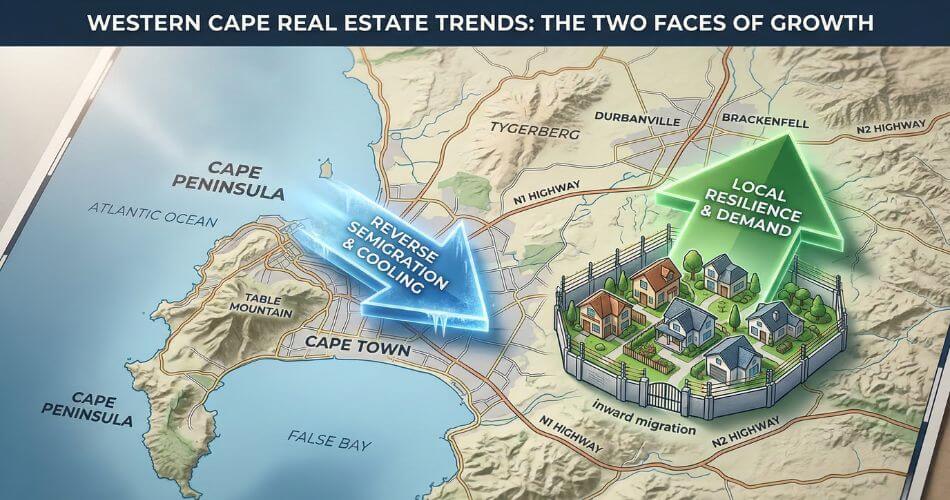
The massive influx of inland buyers between 2020 and 2023 dramatically inflated coastal property prices. By 2026, a notable reverse semigration trend will have firmly established itself in the market.
A measurable segment of buyers is returning to Gauteng due to formal corporate return-to-office mandates. They are also aggressively searching for value-for-money real estate that they cannot find on the coast.
The Atlantic Seaboard remains prohibitively expensive, commanding prices five to ten times the metro average. However, the Northern Suburbs exist within a unique socio-economic micro-climate.
This specific geographic corridor is heavily insulated from the negative impacts of the reverse semigration flow. Durbanville and Brackenfell represent the definitive sweet spot for long-term residential stability.
These suburbs continue to experience positive net inward migration from families seeking security and solid municipal governance. They offer the Western Cape lifestyle without the exorbitant coastal price multipliers.
You must effectively contextualize this macroeconomic trend for your anxious local clients. While the broader Cape market may cool down, the local property demand remains highly resilient.
Demand here is driven by established families and retirees, not transient remote workers or aggressive speculators. Sellers should not panic about national headlines as long as they price accurately.
4. Demystifying WCED School Feeder Zones and BELA Act Implications
Access to premium public education is arguably the most powerful driver of real estate valuation locally. Homes near historically excellent schools sell for premium prices and attract intense buyer competition.
However, a highly emotional gap exists between consumer assumptions and actual regulatory reality. Agents who rely on outdated community rumors regarding catchment areas risk severely misleading their clients.
The absolute truth you must communicate is that the provincial education department does not have strict geographical feeder zones. The updated Basic Education Laws Amendment Act does not mandate admitting only local pupils.
Because demand vastly exceeds capacity at schools like Stellenberg High, the individual governing bodies implement rigorous policies. These autonomous policies heavily favour applicants from specific, aligned primary feeder schools.
You build massive trust by explaining this nuanced catch-22 clearly to anxious parents. Purchasing a six-million-rand property in Everglen Manor does not legally guarantee admission to Fairmont High School.
It simply serves as a heavily weighted contributing criterion under the school’s specific admission policies. By guiding parents through these local realities, you transition into an indispensable consultant.
5. Sectional Title vs. Freehold: Explaining 2026 Investment Yields
A fundamental structural shift has permanently altered the local property market landscape. Sectional title residential property price inflation has outpaced freehold price growth for the first time in two decades.
Nationally, sectional title properties now account for more than half of all residential sales. You must explain why this is happening and how it applies to the local inventory.
This surge is driven by absolute affordability, reduced maintenance costs, and a heightened premium on physical security. Younger buyers and downsizers are actively prioritizing secure, lock-up-and-go units.
These properties feature desirable communal amenities and fall comfortably beneath the transfer duty threshold. This makes them highly accessible to first-time market entrants.
In Brackenfell, the market remains predominantly defined by standard freehold homes. However, estate-bound sectional titles are achieving premium prices and rapid turnover times.
These secure units command an average of R1.53 million and offer excellent gross rental yields. Bellville offers a mix of older freeholds and modern apartments appealing to massive student populations.
Provide a data-driven analysis of levy structures and special levy risks for your active investors. Comparing a new apartment in Buh-Rein to a freehold in Protea Heights proves your objective worth.
The Localized F.O.C.U.S. Framework: Execution Over Volume

The WhatsApp Conversion Engine: Bypassing Email Fatigue
Diagnosing the problem is only the first phase; you must implement a rigid operational system. The F.O.C.U.S. framework provides the necessary architectural discipline to execute your local strategy.
The defining characteristic of the South African digital landscape is the absolute dominance of messaging platforms. Traditional email marketing suffers from extreme consumer fatigue with terrible click-through rates.
The promotions tab is just an overcrowded graveyard for generic real estate newsletters. By stark contrast, direct business messaging achieves phenomenal open rates approaching 98 percent.
This is exactly how to use WhatsApp for real estate to drive actual commercial conversion.
South African consumers view this platform as an intimate and high-trust digital environment. You can share video walkthroughs and market updates without the invasiveness of cold-calling.
Integration of official business APIs allows for sophisticated and compliant audience segmentation. You can send targeted campaigns directly to segmented lists of pre-qualified buyers.
This completely bypasses algorithmic suppression and generates immediate, trackable intent. It bridges the gap between passive browsing and active, highly profitable conversation.
Facebook Community Forums: Becoming the Hyper-Local Knowledge Broker
Organic reach on standard public business pages has plummeted over the years. However, private community-specific groups remain a powerful bastion of high-intent local engagement.
Groups like the Durbanville Community Forum serve as the ultimate digital town square. Residents go there to debate municipal issues, seek local services, and share security updates.
The strategy here is not to spam the feed with repetitive graphics or generic property listings. You must position yourself as the community’s primary and most reliable knowledge broker.
Consistently answer regulatory questions and provide updates on municipal infrastructure projects like the Kuils River Catchment management. This is the gold standard of real estate lead generation in South Africa.
Offer transparent, jargon-free analysis of local economic shifts without asking for anything in return. This consistent value creation establishes deeply rooted localized authority.
When a community member eventually needs a home valuation, they do not search random portals. They directly contact the recognized expert who has consistently helped their digital enclave.
The 90-Day Challenge: Committing to Intent-Driven Value Over Algorithmic Noise

The final element of the framework is committing to a minimum operational timeline. You need ninety days to compound trust and override the algorithmic noise of the local market.
Fix one goal immediately to transition away from reactive digital lead-chasing. Focus strictly on generating inbound inquiries from a very specific subset of the local market.
Commit to one platform by moving all primary content creation to a unified messaging ecosystem. Cease all expenditures of time and mental energy on platforms that do not yield transactional intent.
Define your client audience with absolute granular precision. Target established homeowners in Sonstraal Heights who are actively analyzing the Durbanville property market trends for 2026.
Unsubscribe from the noise by instituting a total ban on unmodified machine-generated copy. Reject the industry pressure to participate in viral trend-chasing or silly meme culture.
Stay the course over a rolling three-month period without wavering. Produce one piece of deeply researched content per week, answering the core questions detailed above.
Distribute this content via direct broadcast messages to your segmented lists and local groups. This unwavering commitment will consistently outperform the mere volume of generic digital effort.
The local property market is brutally unforgiving to the generic practitioner who relies entirely on automated systems. It is highly lucrative for the specialized consultant who deeply understands the practical anxieties of the local consumer.
Abandon the highlight reel, reject homogenization, and ruthlessly focus on building genuine trust through process documentation. Clarity of strategy and hyper-local relevance will always beat sheer volume and cheap virality.
Stop blending in with the crowd and start answering the hard questions your clients are actually asking. Once you master how to stand out as a real estate agent, you will completely dominate your micro-market.
About the Author
Andre Swart is a respected leader in Brackenfell real estate with over 20 years of results-driven experience. Through his platform, “Andre Swart Inspires,” he moves beyond simple property sales to share the proven mindset, strategies, and habits that build lasting success.
Grounded in integrity, Andre’s mission is to mentor the next generation of top agents and provide homeowners with the trusted guidance they deserve.